Insects of Samoa and other Samaon terrestrial arthropoda. Pt. 6, Fasc. 2, Nematocera / by F.W. Edwards.
- Edwards, F. W. (Frederick Wallace), 1888-1940.
- Date:
- [1928?]
Licence: In copyright
Credit: Insects of Samoa and other Samaon terrestrial arthropoda. Pt. 6, Fasc. 2, Nematocera / by F.W. Edwards. Source: Wellcome Collection.
34/84 page 54
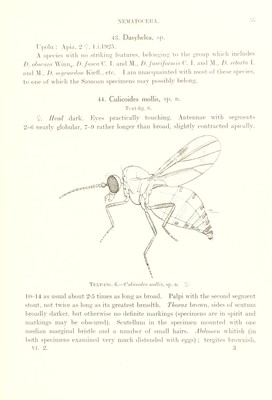
![constrictod a])ically ; 10-14 almost t yliiidiical, gradually lengthened, 14 with more delinite tei'ininal stylet than in Thorax dark <;reyisli-])rown, with slight and in'egular grey reflections, scntellum in ^ hardly lighter, in $ reddish- brown. Mesonotal haii’s short and dark'; about eight marginal scutellar bristles. Abdomen blackish, without definite markings. ]-|ypopygium rather small. Ninth tergite with short, rounded terminal })rocesses. Ninth sternite slightly produced in middle. Clas])ers simple, short, only about half as long as side- piece ; basal half stout and hairy, apical half more slender and bare, bluntly pointed. Basal structures quite symmetrical, the free distal jmrts of both parameres being absent (unless represented by short appendages which seem to be attached to the mesosome). Legs dark brownish, unmarked ; tarsi some¬ what lighter. Claws simj^le. 11 op/6' with moderately dense and uniformly distributed decumbent niacrotrichia, greyish in colour. Costa reaching a little beyond middle of wing. Radial cells equal in length, the first so narrow as to be indistinguishable except in a mounted wing, the second fully three times as long as broad (including the bordering veins in the width of the cell) ; veins not very dark. Halteres yellowish. Wing-length 1*2 mm. Savaii: Matavanu Crater, 2 4 13.v.1924 (Bryan). Differs from most species of the genus in the unusually long second radial cell. 42. Dasyhelea, sp. Cf. D. inconspicuosa, Carter, Ingrain and Alacfie, Ann. Trop. Med. and Parasil., xv, p. 191, 1921. Tutuila ; Pago Pago, 1 l.x.1923 (Swezey and Wilder). Savaii: Mata¬ vanu Crater, 1 $, 13.v.1924 (Bryan). Fiji : Labasa, 12 (^, 2.xii.l922. These examples agree rather well with the description of the West African D. ineonspieuosa, and vdth specimens in the British Museum so determined by Ingram. There are some small differences in the hypopygium which may indicate a specific or varietal distinction, the chief of which are as follows : Processes of ninth tergite with broad bases, bearing several bristles ; processes of aedoeagus much shorter. According to the description the wings are “ densely clothed with decumbent hairs,” but this is hardly accurate ; the hairs are rather scanty, leaving bare lines along each side of the veins (as in D. jlaviventris Goet.).](https://iiif.wellcomecollection.org/image/b29809071_0034.jp2/full/800%2C/0/default.jpg)