Insects of Samoa and other Samaon terrestrial arthropoda. Pt. 6, Fasc. 2, Nematocera / by F.W. Edwards.
- Edwards, F. W. (Frederick Wallace), 1888-1940.
- Date:
- [1928?]
Licence: In copyright
Credit: Insects of Samoa and other Samaon terrestrial arthropoda. Pt. 6, Fasc. 2, Nematocera / by F.W. Edwards. Source: Wellcome Collection.
36/84 page 56
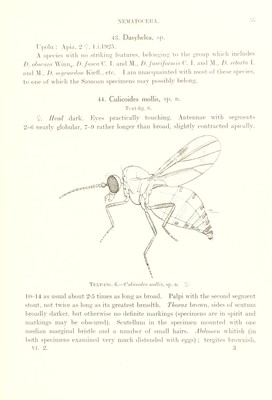
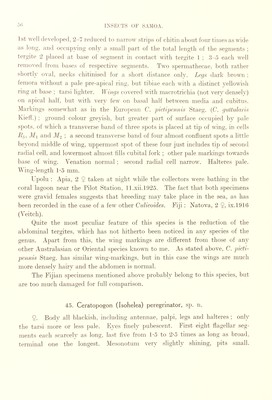
![1st well developed, 2-7 reduced to nai i’ow stri])s of cliitiii about four times as wide as louo'. and occupyiug' only a small ])art of tlie total leu^tli of tlie segments ; tergite 2 {)laced at base of segment in contact with tergite 1 ; M-5 eacli well removed Irom bases of I'espective segments. Two s})erniathecae, both rather shortly oval, necks chitinised for a short flistance only. Lcfjs dark brown ; femora without a ])ale pre-a])ical ring, })ut tibiae each with a distinct yellowish ring at base : tarsi fighter. IFiar/s covered with macrotrichia (not very densely) on apical half, but with very few on basal half between media and cubitus. Mai 'kings somewhat as in the European C. jnctipennis Staeg. {C. ffidtularis Kieff.) ; ground colour greyish, but greater part of surface occupied by pale spots, of which a transverse band of three sjjots is placed at tip of wing, in cells /4, d/i and d/._> ; a second transverse band of four almost confluent sjjots a little beyond middle of wing, uppermost spot of these four just includes tip of second radial cell, and lowermost almost fills cubital fork ; other pale markings towards base of wing. Venation normal ; second radial cell narrow. Halteres pale. Wing-length 1*5 mm. Upolu : Apia, 2 $ taken at night while the collectors were bathing in the coral lagoon near the Pilot Station, ll.xii.l925. The fact that both specimens were gravid females suggests that breeding may take j^lace in the sea, as has been recorded in the case of a few other Culicoides. Fiji: Natova, 2 $, ix.l916 (Veitch). Quite the most peculiar feature of this species is the reduction of the abdominal tergites, which has not hitherto been noticed in any species of the genus. Apart from this, the wing markings are different from those of any other Australasian or Oriental species known to me. As stated above, C. picti- pemiis Staeg. has similar wing-markings, but in this case the wings are much more densely liaii'y and the abdomen is normal. The Fijian specimens mentioned above probably belong to this species, but are too much damaged for full comparison. 45. Ceratopogon (Isohelea) peregnnator, sp. n. $. Body all blackish, including antennae, palpi, legs and halteres ; only the tarsi more or less ])ale. Eyes finely pubescent. First eight flagellar seg¬ ments each scarcely as long, last five from 1-5 to 2-5 times as long as broad, terminal one the longest. Mesonotum very slightly shining, pits small.](https://iiif.wellcomecollection.org/image/b29809071_0036.jp2/full/800%2C/0/default.jpg)