Insects of Samoa and other Samaon terrestrial arthropoda. Pt. 6, Fasc. 2, Nematocera / by F.W. Edwards.
- Edwards, F. W. (Frederick Wallace), 1888-1940.
- Date:
- [1928?]
Licence: In copyright
Credit: Insects of Samoa and other Samaon terrestrial arthropoda. Pt. 6, Fasc. 2, Nematocera / by F.W. Edwards. Source: Wellcome Collection.
40/84 page 60
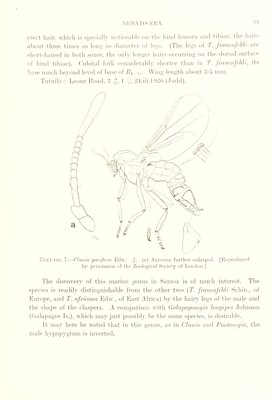
![GO 49. Ablabesmyia notabllis tSkiiisc. Proc. Liini. Soc. A’.,S’. Wales (2), iv, ]). 2SO, 188!!. Mas. yaf. /hoifj., xv, ji. 208, litlT. (1) 'fatii/jias aiuiiilis L., Kidlcr. An)}. I polu: Apia, 2 9, xii.1924. Also 5 $ in Jh'itisli Museum from Queens¬ land, Townsville (Hill). A. iiolabilis appears to be the Australasian representative of the widely spreatl A. nioiiilis (Linn.), from which it differs slightly in wing-markings, as also in its much smaller average size. 50. Ablabesmyia, sp. I poll! : A])ia, 1 9 (too damaged to describe), 31.v.1924. A very small species, with the basal half of the wing dark ; perhaps identical with one of which J have examined specimens from Fiji and Hong Kong. Clunioxinae. 51. Clunio pacificus Edwards. Pioc. Zool. Soc. Lujidon, 1926, ]). 790. Text-fig. 7. Upolu : Apia, “abundant in air over seashore, 8 p.m., Il.xii.l925, Pilot Station.” Tutuila : Pago Pago, 1 at sea-level, 18.iv. (Kellers). A marine species, much resembling the well-known Eiu’opean C. inarinus Hal., but differing in various details, such as the shorter antennae, hind tarsi and coxae. The female has not been obtained, but will doubtless be found to resemble C. marinus in having functional legs but no wings. 52. Thalassomyia pilipes, sjj. n. O $. Closely resembles the European T. fraiienfeldi Schin., differing as follows ; General colour darker, body almost black. Hypopygium of ^ with bristles on (morj)hologically) ventral side of side-piece shorter, but flattened and rather scale-like ; a number of similar bristles are present on inner face of side- piece at base, which is not the case in T. frauenfeldi; claspers strongly bilobed at tip, additional lobe being developed on inner (flexor) surface. Cerci of $ slightly anti evenly widened towards base, instead of suddenly and greatly enlarged on basal half. La.st abdominal sternite of $ Avith feAA’er hairs, which are (lark in colour instead of yellow. Legs of q (but not of $) Avith rather long](https://iiif.wellcomecollection.org/image/b29809071_0040.jp2/full/800%2C/0/default.jpg)