Insects of Samoa and other Samaon terrestrial arthropoda. Pt. 6, Fasc. 2, Nematocera / by F.W. Edwards.
- Edwards, F. W. (Frederick Wallace), 1888-1940.
- Date:
- [1928?]
Licence: In copyright
Credit: Insects of Samoa and other Samaon terrestrial arthropoda. Pt. 6, Fasc. 2, Nematocera / by F.W. Edwards. Source: Wellcome Collection.
50/84 page 70
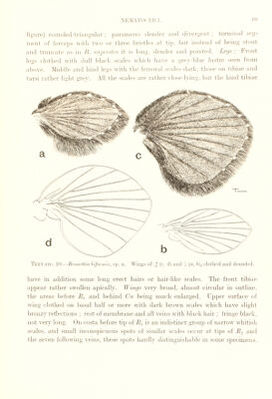
![Lon« erect pale oreyisli liairs occur towards the l)ase of //, and JL, hair other¬ wise dark. A lariic tuft ol very lono- blackisli scales on alula. Under surface of winsj; entirely clothed Avith bronzy-l)lack scales, which are rather narrower in radial cells towards tip of wing. /A, ending iniinediately above wing-tip. ffalteres (hn k. Wing 2-5 X 2-2 nun. 5. ^ erticils of antennae less dense than in the (^, hairs more spreading and more irregular in length. Necks ol flagellar segments shorter. A ratlier dis¬ tinct white S])ot at tip of first hind tarsal segment. Wings much narrower, th.e costal and anal areas not being enlarged. Fringe on posterior margin much longer. White spots round margin of wing more distinct, especially the one on costa before tip of Bi, which is larger than the others. No scales on upper surface of wing, membrane and veins alike being clothed with black hairs. On most of the veins towards base of wing the hairs are long and erect; no pale hairs on Bi and B.;,, but a few towards the base of Cu. Under siu'face of wing entirely covered with scales as in the q. Wang 2-0 X mm. Upolu : Apia, 2 q, 4 $, ii.l925, reared from rotten grass ; 1 23.i.l924 ; 1 o, 1 $, 6.V.1924 ; 3 $, 9.vi.l924 ; 1 ^ (type), xii.1924. Also 1 J', no locality noted (O'Connor), and some damaged females (identity not certain) from Manna, Tan, 27.ix.1923 (Swezey and AVilder). Tutuila : Pago Pago (Swezey and Wfilder) and Savaii, Safune (Bryan). Fiji: no exact data, 2 1906 (Knowles) ; Nausori, 1 i.l921 (Evans) ; Suva, 5 2 $, 17.iv.l921, 28.30.1922 (Simmonds). This interesting species superficially resembles the common and widely- distributed B. albonotata (Bnm.) {B. indica Eaton), but in the female sex differs in having the whole of the under side of the wing scaly, whereas in B. albonotata the scales are present at the base only. B. atrisquamis (Brim.) and B. argenteo- punctata (Brim.) are still closer to the new species, but have been insufficiently characterised for exact comparison. I have examined a male from Peradeniya, Ceylon, which may belong to B. atrisquamis, and this differs conspicuously in the shajie of the forceps. The Fijian examples were doubtfully determined by Tonnoir as B. argenteopunctata Brum, the description of which agrees with our specimens, but pending confirmation of their identity with the Indian form the (Samoan and Fijian specimens are best treated as distinct. There is a remarkable difference in the sha])e and vestiture of the wings in the two sexes, mid it is ju.st possible that two species may be involved. All are referred to one species because all the males are of one type and all the females of](https://iiif.wellcomecollection.org/image/b29809071_0050.jp2/full/800%2C/0/default.jpg)