Insects of Samoa and other Samaon terrestrial arthropoda. Pt. 6, Fasc. 2, Nematocera / by F.W. Edwards.
- Edwards, F. W. (Frederick Wallace), 1888-1940.
- Date:
- [1928?]
Licence: In copyright
Credit: Insects of Samoa and other Samaon terrestrial arthropoda. Pt. 6, Fasc. 2, Nematocera / by F.W. Edwards. Source: Wellcome Collection.
6/84 page 26
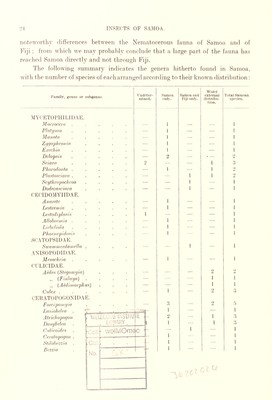
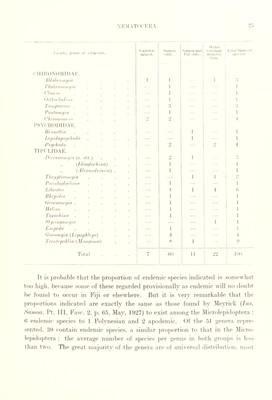
![2() ol tlio roinnindor boing i^alaontropical. Only four of the genera appear to be eiuleinic' to the racilic, Zy(jophw)H(( and Dodccdstmard among tlie Myceto])hilidae, AlJoJd'emia among the CecidoTiiyiidae and Ponlomyia among the Chironomidae. Ol those tliree Do(lrcnf^riar(( has Ix'on found in l^hji and may perha])S {)rove to be an introduction ; tlie other three liave at ])resent been found only in Samoa. All are monotypic. Only one genus {Troitepohlia) has undergone an extensive local develop¬ ment ; m most other eases where several s])eeies of a genus occur (c.r/. Chiw)io)))US, Lildiofes) they are unrelated, and evidently reached Samoa independently. Hopkins (Ins. Sawoa, Pt. Ill; Fasca I, ]). 5, April, 1927) has suggested in his account of the butterflies that the fauna of We,stern Samoa (Upolu and Savaii) may have come in part directly from New Guinea, and that of American Samoa (Tutuila and the Manna group) mainly by way of Fiji and Tonga. The collections of Nematocera afford little evidence for or against this suggestion, largely because of the scantiness of the material from the American islands. Only three species in the collection have been obtained on Tutuila and not on Upolu or Savaii ; one of these {Plastosciara flavibasis) has also been found in Fiji. Seven others (apart from apodemic species) have been found on Tutuila as well as on the other islands, and two of these {Dodecasciara dehUis^ and Trente- pohlia brevicelJida) are also known from Fiji. There is no indication in the material studied of any tendency to the for¬ mation of di.stinct i.sland races within the Samoan group. A large number of species have ])een obtained from more than one island, but so far as observed the variation which occurs is individual only and not local. As regards local di.stribution, two conclusions seem to be indicated fi'om a study of the available data : (1) mo.st of the apodemic species are found chiefly at the low levels, although several {e.y. Plasiosciara pacifico. Aedes variegedns, Atrichopogon jacobsoni) have penetrated into the mountains ; (2) many more sjoecies are found in the higher fore.sts than in the coastal belt. By far the greater number of s])ecies belong to genera whose members are knowji to breed in decaying or fermenting organic matter. This applies to all the Sciarinae, some at least of the Cecidomyiidae, the single Scatopsid and Anisopodid, all the Ceratopogonidae excejff Stilobezzia and Bezzia, all the I’svcliodidae. and also Dicrdnoniyia. Libnotes, Rliipidia, Btyrwgomyia and probably othei's among the Tij)ulidae. Such s[)ccies would readily find lodgment](https://iiif.wellcomecollection.org/image/b29809071_0006.jp2/full/800%2C/0/default.jpg)