Insects of Samoa and other Samaon terrestrial arthropoda. Pt. 6, Fasc. 2, Nematocera / by F.W. Edwards.
- Edwards, F. W. (Frederick Wallace), 1888-1940.
- Date:
- [1928?]
Licence: In copyright
Credit: Insects of Samoa and other Samaon terrestrial arthropoda. Pt. 6, Fasc. 2, Nematocera / by F.W. Edwards. Source: Wellcome Collection.
61/84 page 81
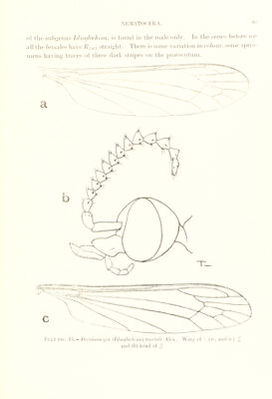
![NKMA'nxiCHA. HI indicate that the Samoan form is varietally distim i ; the ventral apixmda^e of the side-piece is shorter than shown in Alexanders and the clasja'i' is rather In'oader, its outer margin less concave, d’lu' female (not hitherto described) dilTers from the male in the much smaller st iuina, this sexual dillerema* bein^ lonnd also in several other small sj)ecies of Lthii()/(\s. is the most easterly representa,tiv(‘ of a small yroup, ap])arently of Anstro-Malavan origin, which includes L. velfclnaNti hldw. (Fiji), L. hchrideiisit^ Hdw. (New Hebrides) and L. loxopei Edw. (Burn) ; all thes(' might pei'haps la^ regarded as varieties of L. jijienxis, and might be l■eferl■ed with almost ecpial pi'opriety to the genus Lhnnohia. 75. Libnotes perkinsi ((Irimshaw). Liiiinohla perkinsi Urimshaw, Fauna Haicaiiensis Dipl., iii, p. (), I'.tol ; Alc.xandcr. /'/or. Hun. Fnt. For., v, p. 24i), 1923. Libnotes perkinsi Atwandor, ILiJl. Brookhpi Fnl. For., vi, p. 9, 1921 ; Ed-\vard.s, Ann. Maf/. iXal. Hist., (9), xx, p. 239, 1927. Upolu : Apia, 2 8 $, xii.l924-ii.l!)25 ; Vailima, 1 12.xii.1925 ; Malo- lolelei, 2,000 ft., 2 1 13.ii.l924, vii.1924. First described from a specimen from Hawaii, this rather distinct sj)ecies has since been found in Tahiti and Fiji, and has also been recorded by Alexander fr’om Apia. It is not yet known to occur in Papua or on the mainland of Australia. 70. Libnotes strigivena (Walk.). Limnobia slngivena Walker, Journ. Linn. Foe. Land., v, ]). 229, 18()1. Libnotes slrinicena Skiise, Proc. Linn. Foe. N.F. Ito/ci', (2), iv, ]>. 787, 1889. Upolu : Apia, 1 28.x.1925 ; Malololelei, 2,000 ft., 3 (one reared from larva found under dead bark), 25-27.iv., 2.vii.1924 ; Vaea, 1 $, 20.xii.l924. Tutuila : Pago Pago, 1 14.xii.l925. Also 1 $ from Tonga, Nukualofa, 22.ii.1925. The species is known to be found in Ne\v Cfriinea, Northern Australia and Fiji ; it has also been recorded, but probably in error, from Java. The series before me shows some variation. The larger and darker speci¬ mens have the margin of the praescutum broadly dark, and indications of four praescutal stripes ; distinct scutal stripes, and a median dark line across the scutellum and postnotum. In the lighter specimeiisthe.se thoraeic markings are less distinct. There is usuall) a dark spot on the middle coxa, which is absent in the t}7)e fr’om New (friinea. The single damaged sjiecinien from Tonga has the dark ring of the front femora broadei' tlian usual, and including the whole tip.](https://iiif.wellcomecollection.org/image/b29809071_0061.jp2/full/800%2C/0/default.jpg)