Insects of Samoa and other Samaon terrestrial arthropoda. Pt. 6, Fasc. 2, Nematocera / by F.W. Edwards.
- Edwards, F. W. (Frederick Wallace), 1888-1940.
- Date:
- [1928?]
Licence: In copyright
Credit: Insects of Samoa and other Samaon terrestrial arthropoda. Pt. 6, Fasc. 2, Nematocera / by F.W. Edwards. Source: Wellcome Collection.
64/84 page 84
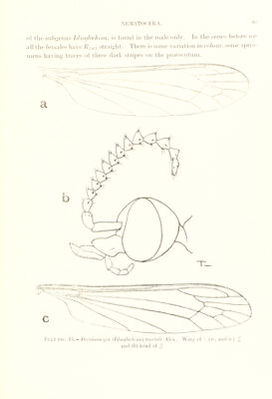
![small aiTossorv Cmoor-liko ]m)cess of the side-piece wliicli cliaracterises I). i^ordnJa. It is ]»i'o}»al)le tliat tlie last-named will also l)e found to occur in Samoa, as it has a wide distril)ution from India to Kiji, Tahiti and (Queensland. 80. Dicranomyia upoluensis, sp. n, 5. Head ochreous. darker at sides. Front as wide as three or four facets. Proboscis dark brown, as loni;- as head. Antennae witli lir.st four or five .seg¬ ments ochreons. re.st darker ; all flagellar segments very sliortlv oval, verticils short. Thorax ochreous, rather strongly pruiiiose exce])t on scutellum and postnotum ; praescutum with three rather l)road and distinct brown stripes, lateral pair continued aci'oss scutum on to sides of scutellum. An ill-defined dark brown pleural stripe extending from neck to ba.se of abdomen. Abdomen dark brown (perhaps discoloured in case of type), tip ochi’eous. Cerci rather long, straight, tips rather blunt. Legs ochreous, tips of femora slightly darkened. Claws with usual small basal tooth. WLujs hyaline, veins dark ; no stigma. <S’c ending above base of Bs ; Sco retracted to near iniddle of R. Rs gently curved, fully twice as long as basal section of ,5. Tip of /?i sharply turned up and much shorter than r, which is long and curved. Discal cell open, cell J/3 short. CuiO rather more oblique than usual and placed a little before f'M. Anal angle rather prominent. Halteres ochreous. Wing-length 4*5 mm. Upolu : Aleipata, Lalomanu, type and one other $, xi.l924. On account of the long straight cerci, prominent anal angle, and some details of venation, this species seems to be related to the subgenus Idioglochina, but in the absence of the male its true position is uncertain. No other known species of Idioglochina has a dark pleural stripe. 81. Dicranomyia (Idioglochina) tusltala (Alex.). Text-fig. I). Rhipiilid tiisitaki Alexander, Bull. Brooldijn But. Boc., xvi, ]>. U), 1921 ; 1). (Idtoplochnui) tusitala , Alexander, Can. Enl., liii, p. 207, 1921. Upolu : A])ia, G 3 $, 3.ii.l924, 17.xii.l925. Tutuila : 1 $ on board ship, 22.iv. 1903 (M. .1. Nicoll; Earl of Crawford’s expedition, voyage of tlie Yalhalla). Also 1 $, probably of this species, from Tonga, Haapai, 2G.ii.l925. The ])eculiarity of venation (/U 13 curved towards 7^4+5 near base, so that the cell R\_ is unusually large) on which Alexander partly based his definition](https://iiif.wellcomecollection.org/image/b29809071_0064.jp2/full/800%2C/0/default.jpg)