Insects of Samoa and other Samaon terrestrial arthropoda. Pt. 6, Fasc. 2, Nematocera / by F.W. Edwards.
- Edwards, F. W. (Frederick Wallace), 1888-1940.
- Date:
- [1928?]
Licence: In copyright
Credit: Insects of Samoa and other Samaon terrestrial arthropoda. Pt. 6, Fasc. 2, Nematocera / by F.W. Edwards. Source: Wellcome Collection.
70/84 page 90
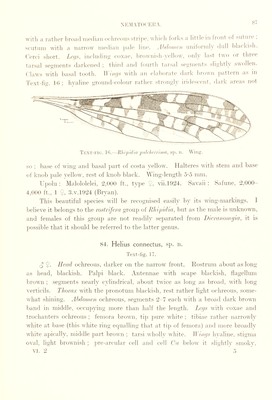
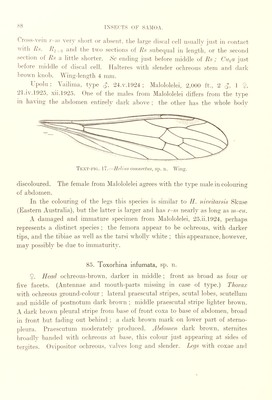
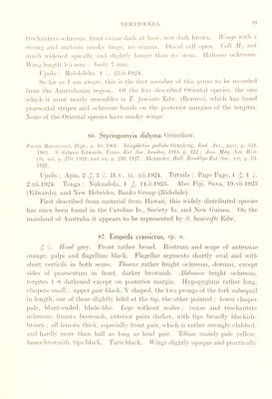
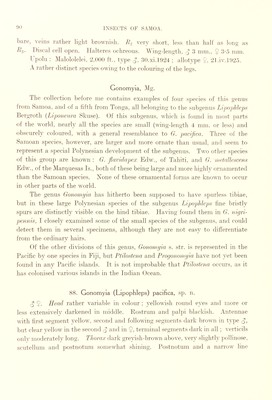
![bare, veins Tatlicr lijilit broAviiisli. J\*.^ veiv slioiT, less than ball as lono' as Discal cell open, llalteres ocbreous. Win^r-lenotli. nun., $ :}-5 nnn. r])olii : Malololelei. 2,000 ft.. tv])e :b).xi.H)24 : allotype 2, 21 .iv.I<>2.j. A rather (listinct s])ecies oAviny to the colouring of fJie legs. Gonomyla, Mg. The collection befoi'e me contains exani])les of four sjiecies of this genus from Samoa, and of a fifth from Tonga, all belonging to the siibgemis Lipophleps l^ergroth {L}po)tci(ra Skiise). Of this siibgeims, which is found in most parts of the world, nearly all the species are small (wing-length 4 mm. or less) and obscurely coloured, with a general resemblance to G. pacijica. Three of the Samoan sjiecies, however, are larger and more ornate than usual, and seem to represent a sjiecial Polynesian development of the subgenus. Tavo other species of this grou]) are knoAAui: G. flaifidapex EdAV., of Tahiti, and G. metaUescens EdAV., of the Marquesas Is., both of these being large and more highly ornamented than the Samoan species. None of these ornamental forms are knoAvn to occur in other parts of the Avorld. The genus Gonomyia has hitherto been sujiposed to have spurless tibiae, but in these large Polynesian species of the subgenus LipopMeps fine bristly spin’s are distinctly visible on the hind tibiae. Ha\ung found them in G. nigri- pennis, I closely examined some of the small species of the subgenus, and could detect them in seA^eral sfiecimens, although they are not easy to differentiate from the ordinary hairs. Of the other diAusions of this genus, Gonomyia s. .str. is represented in the Pacific by one s^iecies in Fiji, but Ptilostena and Proyonomyia ha\’e not yet been found in any Pacific islands. It is not improbable that Ptilostena occurs, as it has colonised various islands in the Indian Ocean. 88. Gonomyia (Lipophleps) pacifica, sp. n. ^ $. Head rather variable in colour ; yelloAvish round eyes and more or less extensi\Tly darkened in middle. Postrum and pal])i blackish. Antennae Avith first segment yelloAv, second and folloAving segments dark broAvu in type but clear A^elloAV in the second ^ and in $, terminal segments dark in all; ATiticils Old A’ moderately long. Tltorax dark greyish-broAvn above, A’ery slightly pollinose. scutellum and postnotum someAvhat shining. Postnotum and a narroAV line](https://iiif.wellcomecollection.org/image/b29809071_0070.jp2/full/800%2C/0/default.jpg)