Insects of Samoa and other Samaon terrestrial arthropoda. Pt. 6, Fasc. 2, Nematocera / by F.W. Edwards.
- Edwards, F. W. (Frederick Wallace), 1888-1940.
- Date:
- [1928?]
Licence: In copyright
Credit: Insects of Samoa and other Samaon terrestrial arthropoda. Pt. 6, Fasc. 2, Nematocera / by F.W. Edwards. Source: Wellcome Collection.
75/84 page 95
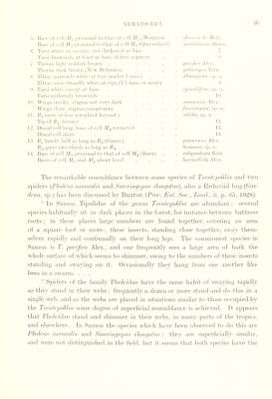
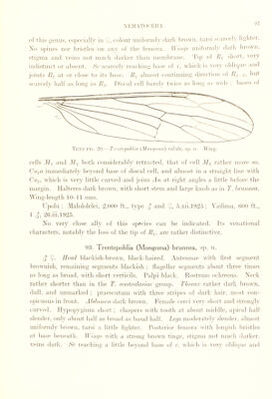
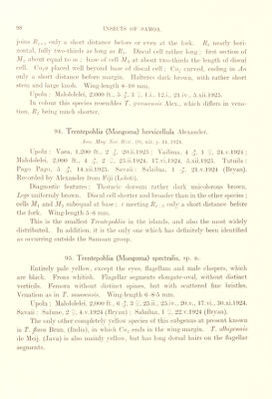
![NK.MAT()( KlIA. 5. l>asi' Ilf cel I ,1/1 iiroxiinal In I hat <il ('i'll M • (W aii^imi) liasi' (if ci'll .!/;[ iiroxiiiial tn t lia( nl ci'll ,1/1 ((i)ii('i'iislaii(l) ti. Tarsi wliita nr crcainN', mil ilarkciiril at liasa 'Tarsi lirowiiish, at least at liase nf TirsI seitiueiit 7. 'Thorax' lialu reihlish-lirowii ..... 'Tliora.x (laik lirowii (New Ili'liridcs) 8. 'I’iliiac iiarrowlv wliite at tips (under I mm.) 'Tiliiae mori' iiroadly white at tips (1-5 mm. or more) It. 'Tarsi white except at liasc ..... 'Tarsi uuiformlv lirownish ..... III. Winys smoky. Stiyma not very dark Winys clear, stiyma conspicuous .... 1 1. A’l more or less atrophied hcyoud /• ... 'Tip of 1\\ distinct ....... 12. Discal cell hmy. base of cell d/.j ret ract ed Discal cell short ....... 13. A'.j barely half as long as (({iiam.) R., (piitc two-thirds as long as R-^ .... 11. Hasc of cell d/^ proximal to that of cell d/3 (Bum) Bases of cell d/^ and .I/3 about h'Vid dI/scii)■(! de .Mei I. |•(llasnlt■ Sk use. 7. S. pilClJiid .\|e.\. (pihtcIdjtHS Ivlw. tllhdlHIHslil, .sp. u. P. splinilif(>r(i, sp. n. III. SIIIIKX’llsis .Me.X. fiiscislifliiia, s|). n. viiJiiht; s(). n. 12. i;5. 1 I. (IIKlIllCH.sis .Me.X. hniuiK’d, sj). n. sdlxfiddlrdld Ivlw. brcviccUnld Alc.x. The reniai'kaltle resemblance between some sjtecies of TrenfejxjJdid tind two sjiiders {Pholcus ((ncomlis and Snicruifjopu.s cloiifiatm), also a Itednviid biig; dena, sp.) has been discussed by Buxton {Proc. Eiit. Soc., Loud., ii. ]j. (>.5, 1928). In Samoa. Tijtnlidae of the oenus Pnoifepohlia are abundant ; several species habitually sit in dark ])hices in the forest, for instance between buttress roots ; in these places large numbers are found together, covering an area of a scjfuare foot or more ; these insects, standing close together, .sway them- .selves rapidly and continually on their long legs. The commonest species in Samoa is T. pacifica Alex., and one frerpiently sees a large area of bark the whole surface of which seems to shimmer, owing to the numbers of the.se insects standing and swaying on it. Occasionally they hang from one another like bees in a .swarm. . . , Spiders of the family Pholcidae have the .same habit of swaying rapidly as they .stand in their webs; frequently a dozen or more .stand and do this in a single web, and as the webs are placed in situations similar to those occupied by the Treiifejjoldia some degree of superficial resenddance is achieved. It a])pears that Jdiolcidae stand and shimmer in theii’ webs, in many jiaids of the tropics, and elsewhere. Jn Samoa the species which have been ob.served to do this are Pholcu.s aiicondi.s and tS}neri)tf/opux eloupatus ; they are snjierlicially similar, and were imt distinguished in the held, but it seems that both species have the](https://iiif.wellcomecollection.org/image/b29809071_0075.jp2/full/800%2C/0/default.jpg)