Insects of Samoa and other Samaon terrestrial arthropoda. Pt. 6, Fasc. 2, Nematocera / by F.W. Edwards.
- Edwards, F. W. (Frederick Wallace), 1888-1940.
- Date:
- [1928?]
Licence: In copyright
Credit: Insects of Samoa and other Samaon terrestrial arthropoda. Pt. 6, Fasc. 2, Nematocera / by F.W. Edwards. Source: Wellcome Collection.
78/84 page 98
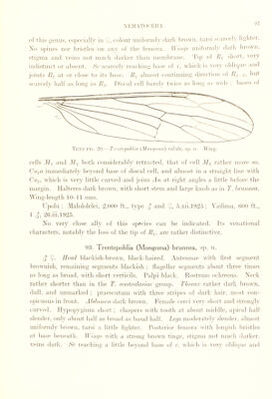
laced well beyond base of discal cell ; curved, ending in An only a short distance before margin, ilalteres dark brown, with rather short stem and large knob. Wing-length 8-10 mm. ITpolu : Malololelei, 2,000 ft.. 5 :> $, l.i.. 12.i.. 21.iv., 5.xii.l025. In colour this s])ecies resembles T. (/udinen.sis Alex., which difTers in vena¬ tion, At, lieiny much shorter. bd. Trentepobha (Mongoma) brevicellula Alexander. .hut. Mafj. Sid. ('.)), xiii. p. 11, 1921. bpolu : Vaea, 1,200 ft., 2 q, 20.ii.l925 ; Vailima, 4- q, 1 $, 24.V.1924 ; Malololelei. 2,000 ft., 4 Ay - $’ 2o.ii.l924, 17.vi.1924, 5.xii.l925. Tutuila : Pago Pago, 5 Ay 14.xii.1925. Savaii : Salailua, 1 q, 21.v.1924 (Bryan). Recorded by Alexander from Fiji (Loloti). Diagnostic features: Thoracic dorsum rather dark unicoloroiis brown. Legs uniformly brown. Discal cell shorter and liroader than in the other species ; cells Ml and d/3 subequal at base ; r meeting R only a short distance before the fork. Wing-length 5-6 mm. This is the smallest TrentepoJdia in the islands, and also the most widely distributed. In addition, it is the only one which has definitely been identified as occurring outside the Samoan group. 95. Trentepobha (Mongoma) spectralis, sj). n. Entirely pale yellow, except the eyes, flagellum and male claspers, which are black. Frons whitish. Flagellar segments elongate-oval, without distinct verticils. Femora without distinct spines, but with scattered fine bristles. Venation as in T. sanioeiisis. Wing-length 6-8-5 mm. Upolu ; Malololelei, 2,000 ft., 6 q, 3 $, 25.ii., 25.iv., 20.v., 17.vi., 30.xi.1924. Savaii : Safune, 2 $, 4.v.1924 (Bryan) ; Salailua, 1 22.V.1924 (Bryan). The only other com])letely yellow species of this subgenus at present known is T. fiava Brim. (India), in which Ch/o ends in the wing-margin. T. alhipennis de Meij. (Java) is also mainly yellow, but has long dorsal hairs on the flagellar segments.](https://iiif.wellcomecollection.org/image/b29809071_0078.jp2/full/800%2C/0/default.jpg)