The treatment of fractures / Charles Locke Scudder ... Assisted by Frederic J. Cotton, M.D.
- Charles Locke Scudder
- Date:
- 1901
Licence: Public Domain Mark
Credit: The treatment of fractures / Charles Locke Scudder ... Assisted by Frederic J. Cotton, M.D. Source: Wellcome Collection.
Provider: This material has been provided by the Augustus C. Long Health Sciences Library at Columbia University and Columbia University Libraries/Information Services, through the Medical Heritage Library. The original may be consulted at the the Augustus C. Long Health Sciences Library at Columbia University and Columbia University.
79/468 page 75
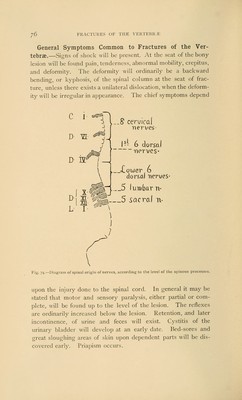
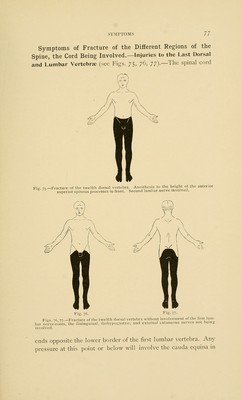
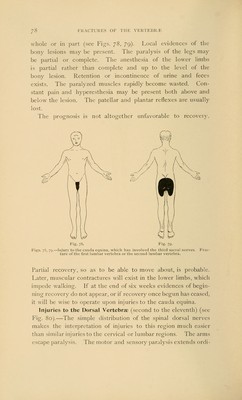
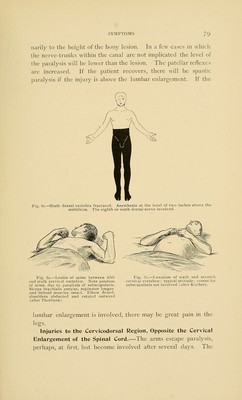
![EXAMINATION / :> fourth dorsal spine. The lower six thoracic nerves arise from the cord between the fourth and tenth dorsal spines. The five lumbar nerves arise from the cord opposite to the eleventh and twelfth dorsal spines. The five sacral nerves arise from the cord opposite to the first lumbar spine. No hard-and-fast rule at present is applicable to the enumeration of the lesions follow- ing the dislocations of definite vertebne. From the combined experience of such clinicians as Gowers, Kocher, Putnam, Den- nis, Walton, Bullard, Thomas, and others the following table is constructed, and is valuable for practical use : TABLE STATING LESIONS FOLLOWING INJURY TO DEFINITE VERTEBR.E. Spinal Segments. Cervical : Musci.es Involved. First, second, third, . . . [Death]. Fourth, Fifth, . Sixth, Seventh, Eighth, Dorsal, . Lumbar: Second, Third, Fourth, Fifth, Vertebrae Dislocated. Skull on atlas, atlas on axis. Reflexes In- volved. Diaphragm. Axis on third cerv Biceps, supinators, deltoid. Third on fourth. Pronators, triceps. Fourth on fifth. Extensors, flexors of wrist. Fifth on sixth. Intrinsic muscles of hand. Sixth on seventh. Abdominal muscles. ical. \ Pupil is small and reaction sluggish. Epigastric, ab- dominal. Cremaster. Eleventh on twelfth Cremasteric. dorsal. Adductors. Outward rotators. Extensors of thigh, flexors Twelfth on first lumbar. Gluteal. of knee. Sacral : First, .... Second, third, fourth, fifth, Extensors of foot. Perineal muscles. First on second lumbar. Plantar. Ankle-clonus. Examination of an Injury to the Spine.—Four questions are to be answered : What was the nature of the accident ? What does palpation of the spine reveal as to the nature of the lesion ? What is the level of the lesion ? Is the lesion partial or com- plete ?](https://iiif.wellcomecollection.org/image/b21207690_0079.jp2/full/800%2C/0/default.jpg)