First lines of physiology : designed for the use of students of medicine / by Daniel Oliver.
- Daniel Oliver
- Date:
- 1844
Licence: Public Domain Mark
Credit: First lines of physiology : designed for the use of students of medicine / by Daniel Oliver. Source: Wellcome Collection.
Provider: This material has been provided by the National Library of Medicine (U.S.), through the Medical Heritage Library. The original may be consulted at the National Library of Medicine (U.S.)
14/526
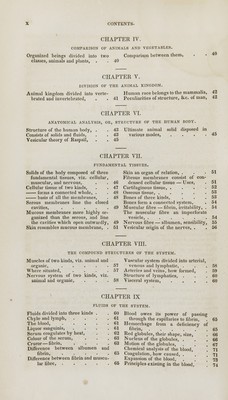
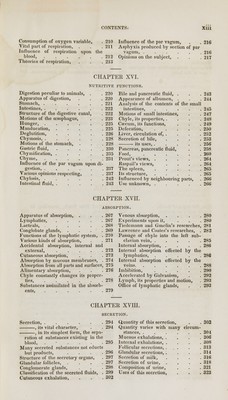
![CHAPTER IV. COMPARISON OF ANIMALS AND VEGETABLES. Organized beings divided into two Comparison between them, • • 40 classes, animals and plants, . . 40 CHAPTER V. DIVISION OF THE ANIMAL KINGDOM. Animal kingdom divided into verte- Human race belongs to the mammalia, 42 brated and invertebrated, . . 41 Peculiarities of structure, &c. of man, 42 CHAPTER VI. ANATOMICAL ANALYSIS, OR, STRUCTURE OF THE HUMAN BODY. Structure of the human body, . . 43 Ultimate animal solid disposed in Consists of solids and fluids, . . 43 various modes, . . . .45 Vesicular theory of Raspail, . . 45 CHAPTER VII. FUNDAMENTAL TISSUES. Solids of the body composed of three Skin an organ of relation, . . .51 fundamental tissues, viz. cellular, Fibrous membranes consist of con- muscular, and nervous, . . 46 densed cellular tissue — Uses, . 51 Cellular tissue of two kinds, . . 47 Cartilaginous tissue, . . . .52 forms a connected whole, . . 48 Osseous tissue, . . . . .53 basis of all the membranes, . 48 Bones of three kinds, . . .53 Serous membranes line the closed Bones form a connected system, . 54 cavities, 49 Muscular fibre — fibrin, irritability, . 54 Mucous membranes more highly or- The muscular fibre an imperforate ganized than the serous, and line vesicle, ...... 54 the cavities which open outwardly, 49 Nervous fibre — albumen, sensibility, 55 Skin resembles raucous membrane, . 51 Vesicular origin of the nerves, . . 56 CHAPTER Vm. THE COMPOUND STRUCTURES OF THE SYSTEM. Muscles of two kinds, viz. animal and Vascular system divided into arterial, organic, 57 venous and lymphatic, . . .58 Where situated, . . . .57 Arteries and veins, how formed, . 59 Nervous system of two kinds, viz. Structure of lymphatics, . . .60 animal and organic, . . .58 Visceral system, . . . .60 CHAPTER IX FLUIDS OF THE SYSTEM. Fluids divided into three kinds . . 60 Blood owes its power of passing Chyle and lymph, .... 61 through the capillaries to fibrin, . 65 The blood, 61 Hemorrhage from a deficiency of Liquor sanguinis 61 fibrin, 65 Jjiquur sanguinis, . . . . »i UDrin, .... Serum coagulates by heat, . . 62 Red globules, their shape, size, . 66 Colour of the serum, . . .63 Nucleus of the globules, . . .66 Cruror—fibrin, . . . .63 Motion of the globules, . . ! 67 Difference between albumen and Chemical analysis of the blood, ', 71 fibrin, . . . • .65 Coagulation, how caused, . . .71 Difference between fibrin and muscu- Expansion of the blood, . . ' 73 lar fibre, 65 Principles existing in the blood, ] 74](https://iiif.wellcomecollection.org/image/b21144412_0014.jp2/full/800%2C/0/default.jpg)




 No text description is available for this image
 No text description is available for this image
 No text description is available for this image