Genetics of resistance to bacterial and parasitic infection / edited by D. Wakelin and J.M. Blackwell.
- Date:
- 1988
Licence: Attribution-NonCommercial-NoDerivatives 4.0 International (CC BY-NC-ND 4.0)
Credit: Genetics of resistance to bacterial and parasitic infection / edited by D. Wakelin and J.M. Blackwell. Source: Wellcome Collection.
267/308 (page 253)
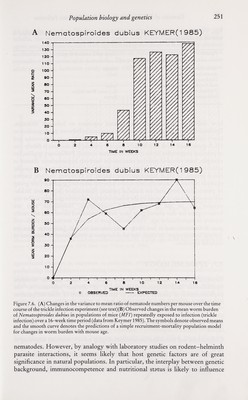
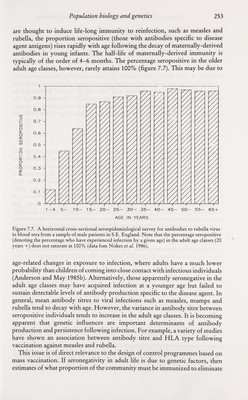
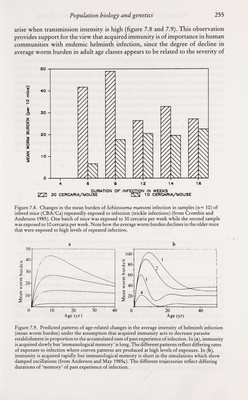
![Population biology and genetics 253 are thought to induce life-long immunity to reinfection, such as measles and rubella, the proportion seropositive (those with antibodies specific to disease agent antigens) rises rapidly with age following the decay of maternally-derived antibodies in young infants. The half-life of maternally-derived immunity is typically of the order of 4-6 months. The percentage seropositive in the older adult age classes, however, rarely attains 100% (figure 7.7). This may be due to Ш > И (Л о а. о а: ш (Л о о Q. О о: CL 1 0.9 0.8 0.7 0.6 0.5 0.4 0.3 0.2 0.1 О т: cd 1-4 5- 10- I Г 15- 20- V V I I 25- 30 Л J / / / V / V, / / // ,/ V /,/ 2] I ■■■!■' I' I' 35- 40- 45- 50- 55- AGE IN YEARS /у 65 + Figure 7.7. А horizontal cross-sectional seroepidemiological survey for antibodies to rubella virus in blood sera from a sample of male patients in S.E. England. Note that the percentage seropositive (denoting the percentage who have experienced infection by a given age) in the adult age classes (20 years +) does not saturate at 100% (data fom Nokes et al. 1986). age-related changes in exposure to infection, where adults have a much lower probability than children of coming into close contact with infectious individuals (Anderson and May 1985b). Alternatively, those apparently seronegative in the adult age classes may have acquired infection at a younger age but failed to sustain detectable levels of antibody production specific to the disease agent. In general, mean antibody titres to viral infections such as measles, mumps and rubella tend to decay with age. However, the variance in antibody titre between seropositive individuals tends to increase in the adult age classes. It is becoming apparent that genetic influences are important determinants of antibody production and persistence following infection. For example, a variety of studies have shown an association between antibody titre and HLA type following vaccination against measles and rubella. This issue is of direct relevance to the design of control programmes based on mass vaccination. If seronegativity in adult life is due to genetic factors, then estimates of what proportion of the community must be immunized to eliminate](https://iiif.wellcomecollection.org/image/b18032151_0268.JP2/full/800%2C/0/default.jpg)