Genetics of resistance to bacterial and parasitic infection / edited by D. Wakelin and J.M. Blackwell.
- Date:
- 1988
Licence: Attribution-NonCommercial-NoDerivatives 4.0 International (CC BY-NC-ND 4.0)
Credit: Genetics of resistance to bacterial and parasitic infection / edited by D. Wakelin and J.M. Blackwell. Source: Wellcome Collection.
83/308 page 69
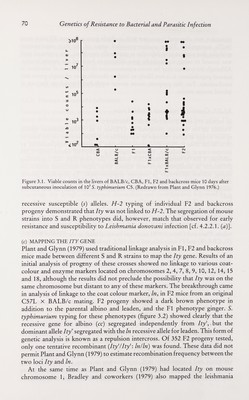
![Bacterial infections 69 resistance was observed consistent with multiple gene influence. F2 mice were 34-2% susceptible. These studies provided some of the first experimental evidence that resistance to infection is genetically regulated. The protocol used was bound to select for multiple gene differences between the mouse strains. Although the process may be more representative of the process of selection in natural populations, it is less likely to lead to identification of single genes and mechanisms. For this purpose, more recent work has focused on the use of inbred mouse strains. 3.3.2.2. Genetics of resistance in inbred mice {a) MOUSE STRAIN DIFFERENCES IN SENSITIVITY Various earlier workers (reviewed by O'Brien et al. 1980a) classified inbred mouse strains as either resistant or susceptible to S. typhimurium on the basis of 50% lethal dose (LD^o) calculations following intravenous, subcutaneous or intraperitoneal inoculation. In some cases (e.g. C3H/HeJ versus other C3H subhnes; CBA/N versus other СБА sublines) the genes {Lps, xid) controlling differences in sensitivity were well known from other functional studies on mouse subline differences in immune responsiveness. To determine genetic control of the major segregation of inbred strains into resistant (R) and susceptible (S) phenotypes, traditional Mendelian genetic analysis was carried out. ф) MENDELIAN INHERITANCE PATTERNS Precise analysis of inheritance of resistance and susceptibility in backcross and F2 mice required the use of a more refined measure of susceptibility than LD^o values. Plant and Glynn (1976) examined bacterial loads in the livers of BALB/c (S), CBA (R) and Fl mice infected with 10' S. typhimurium C5 and showed that resistance was dominant over 5-20 days of infection. From these data they determined that individual mice could be classified as phenotypically R or S on the basis of day 10 viable counts in the infected organs (liver or spleen) following subcutaneous inoculation of 10^ S. typhimurium C5. In F2 and backcross mice derived from CBA X BALB/c matings (figure 3.1), all Fl and Fl X CBA mice had bacterial loads <10^ while backcross to the susceptible BALB/c parent produced a 1:1 segregation of S (>10^ viable bacteria/liver; spleen weights <0-35 g) to R (<10^ viable bacteria/liver; spleen weights <0-25 g). In the F2 generation the overall ratio of R:S mice was 20:6. Although some individual mice in the F2 and backcross generations had liver bacterial counts intermediate between the two parental strains, mice could be typed as R or S using the additional character of spleen weight. This combination of characters also provides good segregation of S and R phenotypes for Mycobacterium lepraemurium infection [cf. 3.5.2.2.(л)]. On the basis of their results Plant and Glynn (1976) proposed that early resistance and susceptibility to S. typhimurium infection in inbred mice was under the control of a single autosomal gene, designated Ity for immunity to typhimurium (Plant and Glynn 1977), segregating for dominant resistant (r) and](https://iiif.wellcomecollection.org/image/b18032151_0084.JP2/full/800%2C/0/default.jpg)

 No text description is available for this image
 No text description is available for this image
 No text description is available for this image