Genetics of resistance to bacterial and parasitic infection / edited by D. Wakelin and J.M. Blackwell.
- Date:
- 1988
Licence: Attribution-NonCommercial-NoDerivatives 4.0 International (CC BY-NC-ND 4.0)
Credit: Genetics of resistance to bacterial and parasitic infection / edited by D. Wakelin and J.M. Blackwell. Source: Wellcome Collection.
84/308 page 70
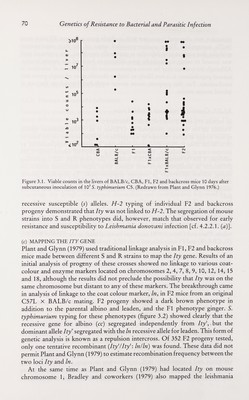
![70 Genetics of Resistance to Bacterial and Parasitic Infection >10° и 0) > Z 10^ ^ 10^ о и ф *) ^ 10^ <10^ I Î ? < CO о < CO о X < CO X Figure 3.1. Viable counts in the livers of BALB/c, CBA, Fl, F2 and backcross mice 10 days after subcutaneous inoculation of lO'' S. typhimurium C5. (Redrawn from Plant and Glynn 1976.) recessive susceptible (5) alleles. H-2 typing of individual F2 and backcross progeny demonstrated that Ity was not linked to H-2. The segregation of mouse strains into S and R phenotypes did, however, match that observed for early resistance and susceptibility to Leishmania donovani infection [cf. 4.2.2.1. (л)]. (с) MAPPING THE ITY GENE Plant and Glynn (1979) used traditional linkage analysis in Fl, F2 and backcross mice made between different S and R strains to map the Ity gene. Results of an initial analysis of progeny of these crosses showed no linkage to various coat- colour and enzyme markers located on chromosomes 2, 4, 7, 8, 9, 10, 12,14, 15 and 18, although the results did not preclude the possibility that Ity was on the same chromosome but distant to any of these markers. The breakthrough came in analysis of linkage to the coat colour marker. In, in F2 mice from an original C57L X BALB/c mating. F2 progeny showed a dark brown phenotype in addition to the parental albino and leaden, and the Fl phenotype ginger. S. typhimurium typing for these phenotypes (figure 3.2) showed clearly that the recessive gene for albino (cc) segregated independently from Ity\, but the dominant allele Ity^ segregated with the In recessive allele for leaden. This form of genetic analysis is known as a repulsion intercross. Of 352 F2 progeny tested, only one tentative recombinant (ItyVIty^: In/In) was found. These data did not permit Plant and Glynn (1979) to estimate recombination frequency between the two loci Ity and In. At the same time as Plant and Glynn (1979) had located Ity on mouse chromosome 1, Bradley and coworkers (1979) also mapped the leishmania](https://iiif.wellcomecollection.org/image/b18032151_0085.JP2/full/800%2C/0/default.jpg)

 No text description is available for this image
 No text description is available for this image
 No text description is available for this image