Medical patents : a letter on the patenting of inventions in connexion with medicine / by John Chapman.
- John Chapman
- Date:
- 1867
Licence: Public Domain Mark
Credit: Medical patents : a letter on the patenting of inventions in connexion with medicine / by John Chapman. Source: Wellcome Collection.
Provider: This material has been provided by The Royal College of Surgeons of England. The original may be consulted at The Royal College of Surgeons of England.
14/16
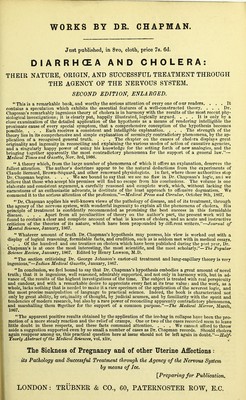
![Preparing for publication, EPILEPSY, PARALYSIS, AND OTHER DISEASES OF THE NERVOUS SYSTEM: Cases illustrative of their Successful Treatment, chiefly by means of Ice. “ Under the influence of these remedial measures, Ur. Chapman has succeeded in six cases, related in the Medical Times, in effecting a cure or marked improvement in epilepsy. This is a result assuredly deserving of attention, and fresh researches may possibly fecundate this ingenious application of a discovery highly creditable to contemporary physiology.—Journal of Practical Medicine and Surgery, Oct. 1863. Dr. Chapman has contributed [to the Journal of Mental Science] some cases of epilepsy, paralysis, aud other diseases of the nervous system, treated successfully chiefly by means of ice. These cases clearly prove the inestimable value of his treatment—a treatment that has not received justice from some of his professional brothers in England.—The Medical Mirror, Oct. 1866. “ It is clear that we possess from his discovery, an excellent remedial agent iu the treatment of con- vulsions and paralysis, and in diabetes.”—Medical Mirror, April, 1867. Now ready, in 8vo, price 2s. 6d. FUNCTIONAL DISEASES OF WOMEN: Cases illustrative of a New Method of Treating them through the agency of the Nervous System, by means of Cold and Heat ; ALSO, AN APPENDIX, CONTAINING CASES ILLUSTRATIVE OP A NEW METHOD OP TREATING EPILEPSY, INFANTILE CONVULSIONS, PARALYSIS AND DIABETES. “ This is an interesting* monograph, by a man of original mind and considerable ability Dr. Chapman states that, by the application of cold to the middle of the spine, it is possible to increase the force and frequency of the heart’s action, and by heat to diminish it. This is opposed to the dicta of Dr. Todd and other clinical teachers, but Dr. Chapman alleges it as a fact, and challenges experiment. Carrying on his experiments, he erects into a therapeutical system the application of cold and heat to the spine in •various parts, and for different periods of time, and claims for this treatment a philosophical interpretation and wide practice. His brochure requires reading and testing clinically. It is original in its views.*’—Lancet, Feb. 20, 1864. “ Dr. Chapman expresses his belief that many maladies not usually held to depend on nervous agency— such as those in the title (diabetes and constipation)—really originate in that manner The subject deserves the serious attention of the profession, not only from the high character of its originator, but also from the amount of evidence which he has already brought to bear upon it. He, however, seems to be as yet only at the outset of his investigations, and promises more detailed information hereafter. In so doing he will confer a great boon on physiology and practical medicine.”—Medical Times and Gazette, Jan. 23,1864. “Nor should he [the student] fail to study the brief monograph of Dr. Chapman on cold and heat in the treatment of the functional diseases of women.**—Clinical Notes on Uterine Surgery, by J. Marion Sims, M.D., p. 41. “ There can be no doubt that any man who will, with an unbiassed and philosophical mind, consider Dr. Chapman’s cases, must admit that he has made a discovery which promises to do much good to suffering humanity. . . . Not only is the result of ice effective towards increasing the vitality of the uterus, and Eromoting the period, but the pain is diminished. The dysmenorrhcea is, in fact, cured It would e well for the patients who are supposed to be suffering from mechanical dysmenorrhcea, if before the uterus was cut with hysterotomes—a proceeding in the hands of some practitioners not always free from danger—that Dr. Chapman’s plan was made the preliminary treatment. Drs. Marion Sims, Greenhalgh, and Routh, would probably cut less often Section III. is the first philosophical essay that we seem to have read on cold feet We must with him admit that ice, applied to certain parts of the spinal cord, will promote the menstrual flow, and produce warm feet; and the nine cases mentioned are fully confirmatory of this view It cannot be doubted, but that the obstetric physician may derive from these views of Dr. Chapman’s great assistance in the treatment of many uterine cases, hitherto almost incurable, always tardy and tedious both to patient and himself. Section IV. treats of haemorrhage and menorrhagic pain cured by means of heat. We are almost better pleased with Dr. Chapman’s results here than with the former. The correctness offormer results following the use of ice is greatly enhanced when we find exactly the opposite effects following the use of heat applied to the spinal centre. We cannot fail to be struck with the rapidity with which the menorrhagia is controlled. Ergot has not the same power; and the advantages of this plan in many cases of fibroids, change of life, flooding, is very con- spicuous. We have read Dr. Chapman’s book with pleasure, and we are pleased with his manner of working. It is clear he has made a very useful discovery, and more useful applications, and he knows it. He is not an enthusiast simply. He is a devoted learner and a modest teacher.”—The Medical Mirror, April, 1867.](https://iiif.wellcomecollection.org/image/b22350032_0016.jp2/full/800%2C/0/default.jpg)