The constitution of barbaloin. Pt. 1 / by H.A.D. Jowett and Charles E. Potter.
- Jowett, H. A. D. (Hooper Albert Dickinson)
- Date:
- [1905]
Licence: In copyright
Credit: The constitution of barbaloin. Pt. 1 / by H.A.D. Jowett and Charles E. Potter. Source: Wellcome Collection.
4/20 page 2
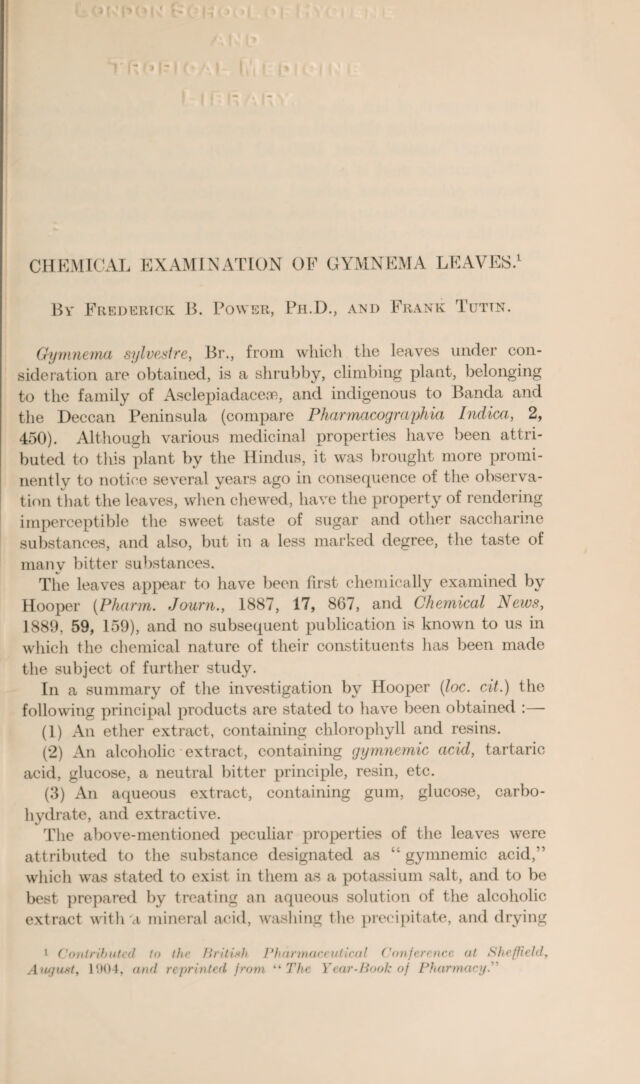
![] -J it in a current of hot air or in a desiccator. The characters of the substance thus obtained were described essentially as follows (compare Chemical News, 1889, 59., 159) :—- 44 Gymnemic acid is a brittle, black, resinous substance, of a greenish colour when reduced to powder. It is insoluble in water, but soluble in alcohol, ether, benzol, and chloroform. With the caustic alkalis it affords fine red solutions, from which it is re-precipitated on the addition of acids. It fuses at about 60°C. into a black liquid of thick consistence ; above 100° it gives off creosotic fumes, and, at a higher temperature, burns with a bright, smoky flame, leaving no ash. It is precipitated by the salts of lead, iron, silver, barium, and calcium, but not by tannin, picric acid, and gelatin solution. It forms insoluble salts with alkaloids, and this accounts for its masking the taste of quinine and other bitter substances. From analyses of the acid, the formula may be deduced.” 4 4 The silver and lead salts of gymnemic acid form black powders, and the analysis of these affords evidence that the acid is monobasic, while the amount of alkali required for its neutralisation indicates a molecular weight corresponding to the above formula. The acid or its salts have not been obtained in anything approaching a crystalline condition ; they dry as do tannic acid and the tannates. The acid is a glucoside. After boiling for about an hour with dilute acid, a dark resinous mass, devoid of the peculiar property of gymnema leaves, remains, and the liquid contains a body which readily reduces Fehling’s solution.” It has, furthermore, been noted by Hooper that 44 chloroform agitated with an alkaline solution of the leaf left a crystalline residue of a brownish colour ; it had a bitter taste, and acted as a sialagogue. With the ordinary alkaloidal reagents it afforded coloured precipitates, but was a neutral principle.” The action of the leaves of Gymnema sylvestre on the sense of taste was investigated several years ago by L. E. Shore, of Cambridge, whose results are recorded in a paper, entitled, 44 A Contribution to Our Knowledge of Taste Sensations ” [The Journal of Physiology, 1892, 13, 191-217). From a large number of experiments in this direction the following conclusions were drawn :— 44 It is accepted that tastes may be divided into four classes, namely, sweet, bitter, acid, and salt, and as examples of these, glycerin, quinine sulphate, sulphuric acid, and sodium chloride](https://iiif.wellcomecollection.org/image/b3060834x_0004.jp2/full/800%2C/0/default.jpg)