[Report 1952] / Medical Officer of Health, East Sussex County Council.
- East Sussex (England). County Council
- Date:
- 1952
Licence: Attribution 4.0 International (CC BY 4.0)
Credit: [Report 1952] / Medical Officer of Health, East Sussex County Council. Source: Wellcome Collection.
11/44 page 9
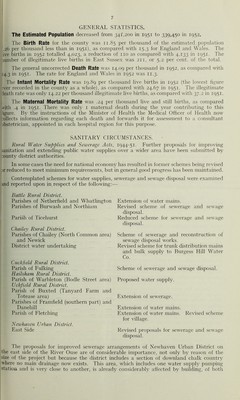
![Routine inspections of plants and dairy operations have been maintained and the ollowing table shows the results of tests of samples taken from all types of pasteurising i-stablishment plants:—- i Class of milk. No. of samples. Appropriate tests. No. of samples. Passed. Failed, j Invalid. Tuberculin Tested (Pasteurised) . . 83 Phosphatase Methylene blue 83 81 1 ^ Pasteurised . . 295 Phosphatase Methylene blue 293 292 - 1 7 “Milk-in-Schools ” Scheme. Supervision of supplies provided under the scheme was j;ontinned. During the year 301 samples were submitted for examination and, of these, only two failed to satisfy the prescribed tests, and the position in general is considered i:o be satisfactor}'. I In nine cases “ Tuberculin Tested ” milk supplies have been replaced by pasteurised inilk and, by the year end, of the 216 school departments participating in the scheme, 212 vere receiving pasteurised milk and four received “ Tuberculin Tested ” milk from approved !>ources. ! While one cannot be entirely satisfied while any raw milk is supplied in schools, the present position is very reassuring, especially as the few sources of raw milk are known to De of very high standard. I INFECTIOUS DISEASES. ' Table V in the Appendix sets out the number of notified cases of the diseases listed. jScarlet fever has risen in numbers from 341 last year to 619 in 1952, there being an appreciable jise (hardly amounting to an outbreak) in the latter part of the year. The disease remained luild. Whooping cough (431 cases, compared with 1,804 l^st year) and measles (1,606, bompared with 4,948) both show a substantial decrease, though it will be remembered that |in 1951 the number notified of each disease was the highest ever recorded. Enteric fever land dysentery both show fewer cases. 0 1 It is a continuing satisfaction and a point of pride to the district medical officers in the bounty that the line “ diphtheria ” continues as a zero record right across. Indeed, of the (simple pleasures still left to the medical officer of health one of the sweetest is to ask a class bf nurses receiving a lecture, “ Which of you has ever seen a case of diphtheria?—and to be greeted by a dead silence, a result which is nowadays obtained on nearly e\'ery occasion. (Nevertheless, freedom from diphtheria can be maintained, like liberty, only at the cost of jconstant vigilance and, when a knowledge of diphtheria as a killing and maiming disease is (fading from the public mind, it is all the more important to keep up pressure by reminders land propaganda. Moreover, those health authorities which expect and wish to maintain la high percentage of immunisation rather than a doubtful cover afforded by having (fewer persons immunised will appreciate that the difference costs money, money which jcould hardly be better spent. , I Measles and whooping cough, although so many cases have occurred, continue to be idecreasingly severe; during the year there were no deaths from either disease. Enquiries of general practitioners and paediatricians show that, although an occasional case is severe, both complications and untoward sequelae are extremely rare. Shortly after the end of 1952, indeed, the question was raised whether notification of either condition any longer !serves a useful purpose. I • ] I Acute poliomyelitis, with 95 notified cases (85 confirmed), showed a substantial rise in incidence compared with 16 cases last year and, starting with three cases in March, was notified in each month until 12th December. Apart from nine cases in or near East Grinstead I Urban District and five in Cuckfield Urban District, almost all the cases were in Hove (23 jconfirmed cases) and in and near Rye (28 confirmed cases). The latter included an outbreak in the autumn which was noficeably related to pupils attending a primary school and their bre-school associates, but elsewhere the majority of patients were over five years old. There](https://iiif.wellcomecollection.org/image/b29186900_0013.jp2/full/800%2C/0/default.jpg)




 No text description is available for this image
 No text description is available for this image
 No text description is available for this image