Antiquitates culinariae, or, curious tracts relating to the culinary affairs of the old English / with a preliminary discourse, notes and illustrations by Richard Warner.
- Date:
- 1791
Licence: Public Domain Mark
Credit: Antiquitates culinariae, or, curious tracts relating to the culinary affairs of the old English / with a preliminary discourse, notes and illustrations by Richard Warner. Source: Wellcome Collection.
Provider: This material has been provided by The University of Glasgow Library. The original may be consulted at The University of Glasgow Library.
45/214 (page 33)
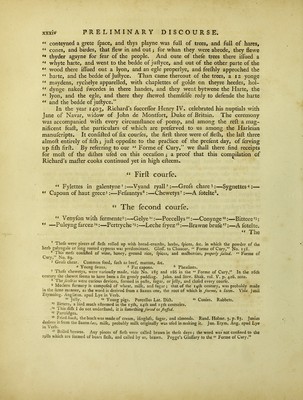
![articles in the formation of one difh, would produce an effect very unpleafant to a palate of this day; and the quantity of hot fpices, that were mixed in almoft all of them, would now be relilhed only by thofe accuftomed to the high-feafoned difhes of the Eaft and Weft-Indies. But the magnificence of Richard was not confined to his table. Superb ex- hibitions and coftly pageantry, were his frequent amufements. The paflion for J,hews, is indeed, common to a dark and uninformed age. Hitherto, literature had made little progrefs among our countrymen; mental refources were as yet unknown; and it was necelfary to recur for entertainment to fomething without; to mummeries, pageantry, and fuch fopperies to fill up the vacant time, and vary the tirefome monotony of a life, in which the interefting purfuits of learning, fcience, and philofophy, had no concern. Froiflart the hiftorian, who was cotemporary with Richard, and appears never to have been more agreeably engaged, than when beholding or defcribing Jhews, has given us various accounts of the pageantries of this fplendid prince. I lhall infert one of thefe details; which will enable us to form fome idea of the amufements of the fourteenth century, and the fpirit of thefe fantaftic and expenfive abfurdities. The following extract, is part of the very long account, which he gives, of the various pageants exhibited, when Ifabel the wife of Richard made her public entry into Paris. *' At the fyrft gate of Saynt Denicet entrynge into Paris, there was a heven “ made full of fterres, and within it yonge chyldren apparelled lyke angelles, “ fwetely fynginge. And amonge them an ymage of our lady holdyng in fygur” [a figure] “ of a lytell chylde playinge by hymfelf with a lytile myl made of a “ greate nutt. Thys hevyn was hyghe, and rychely apparelled with the arines <e of Fraunce, with a baune of the funne fhynynge of gold caftynge his rayes. “ Thys was devyfed by the kynge for the feeft of the Julies. “ Thane whan the Quene and the ladyes were pafte by, than they came a “ fofte pace befor the fountayne in a ftrete of Saynte Denyce; whych condyte “ was covered over with a cloth of fyne azure paynted full of floure de lys of golde, ** and the pyllers were fette full of the armes of dyvers noble lordes of Fraunce; “ and oute of thys fountayne there ifiued in gret ftremes, punent and clarre. And “ about thys fountayne there were young maydens rychly apparelled with rych “ chaplettes on their heades finging melodioully. And they helde in theyre handes “ cuppes and goblettes of golde, of frynge, and gyving to drynk all fuch as “ palled by.” After which was the reprefentation of a battle between the French and Sa- racens. Then followed this pageant. “ At the gate of the Chatelet of Parys, there was a caftell made of woode “ and timber, as ftrongly made, as it ftiuld have endured forty yeares. The “ whych caftell was embatelled and at every lope there was a man at armes, armed “ at all peas (points). And in the fame caftell, there was a bedde made rychli “ encourteyned and apparelled, as it had been to have ftande in the kynges cham- *' ber, and thys bedde was called the bedde of juftyce, and in thys bedde there “ lay, by figure, Saynt Ann. In thys caftell there was a playne, for the caftell F “ conteyned](https://iiif.wellcomecollection.org/image/b24919342_0045.jp2/full/800%2C/0/default.jpg)