Foods: their composition and analysis : A manual for the use of analytical chemists and others. With an introductory essay on the history of adulteration / By Alexander Wynter Blyth. With numerous tables and illustrations.
- Alexander Wynter Blyth
- Date:
- 1882
Licence: Public Domain Mark
Credit: Foods: their composition and analysis : A manual for the use of analytical chemists and others. With an introductory essay on the history of adulteration / By Alexander Wynter Blyth. With numerous tables and illustrations. Source: Wellcome Collection.
Provider: This material has been provided by The University of Leeds Library. The original may be consulted at The University of Leeds Library.
113/673 page 79
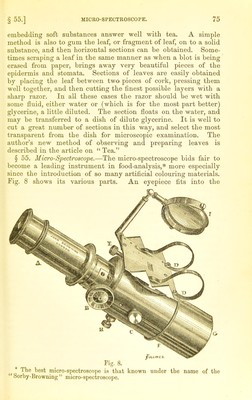
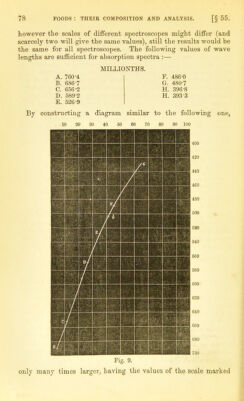
![§56.] at the top, and intersected by the lines giving wave lengths, and then determining the exact position of Fraunhofer's lines on the scale, and mai-king them by crosses on the chart as in the diagram, and lastly, joining the points in a uniform curve, it is possible to get very simply the wave lengths of every portion of the scale. The more uniform the curve, the greater the number of lines determined ; and the larger the chart, the more accurate are the values. Supposing the centre of an absorption-band to be at 10 on the scale: on referring to Fig. 10. Fig. 11. the diagram the curve at 10 is exactly cut by the horizontal line 660, therefore, the wave length would be 660, and so on. It will be necessary to measure in all cases the middle of the absorption-band, or the middle of the spark line. § 56. The ordinary spark spectroscope is not quite so useful to the food-analyst as the micro-spectroscope just described. It will, however, probably be more used when the ash-constituents of food have been thoroughly and scientifically worked out. A very careful search after the rarer metals and elements in the ash- constitiients of plants would, in all probability, be rewarded with the discovery of—if not nev) elements—yet of the wide dispersion of the elements that are presumed not to be widely disseminated. The spectroscope in general laboratory use has only been apjjlied to the diagnosis of potash, litliium, copper, barium, strontium, and a few other flame spectra easily obtained without the aid of electricity; but the interesting and convenient method of examina- tion introduced by Lecocci de Boisboudran has made spark spectra so very easy to be obtained by any one who has a battery, and a Ruhmkofl coil capable of giving a good spark, that there is no](https://iiif.wellcomecollection.org/image/b21507120_0113.jp2/full/800%2C/0/default.jpg)
 No text description is available for this image
 No text description is available for this image
 No text description is available for this image