Oxford silver pennies from A.D.925-A.D.1272 / described by C.L. Stainer.
- Charles Lewis Stainer
- Date:
- 1904
Licence: In copyright
Credit: Oxford silver pennies from A.D.925-A.D.1272 / described by C.L. Stainer. Source: Wellcome Collection.
21/189
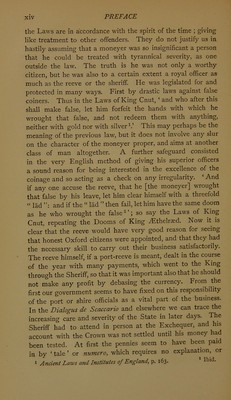
![the Laws are in accordance with the spirit of the time ; giving like treatment to other offenders. They do not justify us in hastily assuming that a moneyer was so insignificant a person that he could be treated with tyrannical severity, as one outside the law. The truth is he was not only a worthy citizen, but he was also to a certain extent a royal officer as much as the reeve or the sheriff. He was legislated for and protected in many ways. First by drastic laws against false coiners. Thus in the Laws of King Cnut, ‘ and who after this shall make false, let him forfeit the hands with which he wrought that false, and not redeem them with anything, neither with gold nor with silver This may perhaps be the meaning of the previous law, but it does not involve any slur on the character of the moneyer proper, and aims at another class of man altogether. A further safeguard consisted in the very English method of giving his superior officers a sound reason for being interested in the excellence of the coinage and so acting as a check on any irregularity. ‘ And if any one accuse the reeve, that he [the moneyer] wrought that false by his leave, let him clear himself with a threefold “ lad and if the “ lad ” then fail, let him have the same doom as he who wrought the false ^ j so say the Laws of King Cnut, repeating the Dooms of King iEthelraed. Now it is clear that the reeve would have very good reason for seeing that honest Oxford citizens were appointed, and that they had the necessary skill to carry out their business satisfactorily. The reeve himself, if a port-reeve is meant, dealt in the course of the year with many payments, which went to the King through the Sheriff, so that it was important also that he should not make any profit by debasing the currency. From the first our government seems to have fixed on this responsibility of the port or shire officials as a vital part of the business. In the Dialogus de Scaccario and elsewhere we can trace the increasing care and severity of the State in later days. The Sheriff had to attend in person at the Exchequer, and his account with the Crown was not settled until his money had been tested. At first the pennies seem to have been paid in by ‘ tale ’ or itumero, which requires no explanation, or 1 Ancient Laws and Institutes of England, p. 163. * Ibid.](https://iiif.wellcomecollection.org/image/b24864705_0020.jp2/full/800%2C/0/default.jpg)
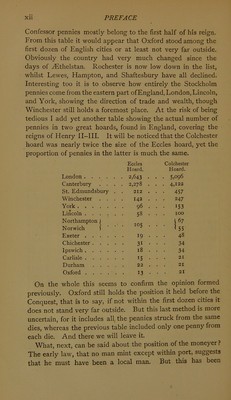


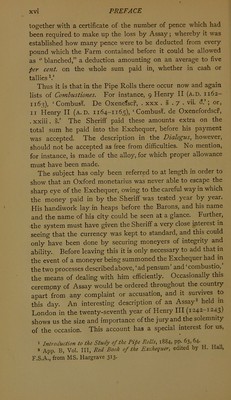

 No text description is available for this image
 No text description is available for this image
 No text description is available for this image