On the etiology of leprosy / by G. Armauer Hansen, assistant physician to the leper hospitals at Bergen, Norway.
- Gerhard Armauer Hansen
- Date:
- [1875]
Licence: Public Domain Mark
Credit: On the etiology of leprosy / by G. Armauer Hansen, assistant physician to the leper hospitals at Bergen, Norway. Source: Wellcome Collection.
Provider: This material has been provided by King’s College London. The original may be consulted at King’s College London.
17/42 page 471
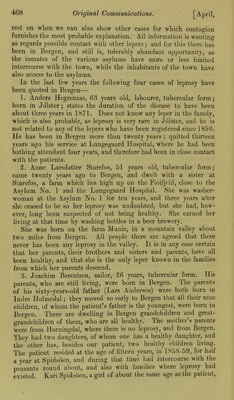
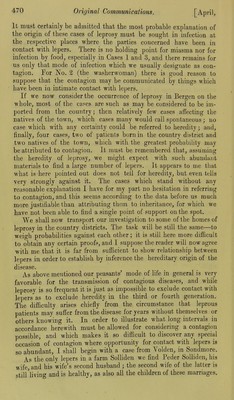
![1875.] On examining the surviving wife, as well as other people who had known the parties concerned well, I could not find that in three generations there had been any other lepers. The first leper. Per SoUiden, rowed during the fishery for many years together with Ellinc^ Staaten and Martin EoiiaestaH, who were both lepers, and there'^was unanimous testimony to Martin having been a leper for many years when he and Per Solliden were constantly chumming too-ether both winter and summer, while EUing Staaten probably became leprous at a later date. Per Solliden died a leper in 1841; his wife married again ; when she became a leper is not known, but she died a leper in 1856, and it was not until 1860 that her second husband was aware of his own leprosy. SoUiden is a mountain farm, as the name denotes, situated on the sunny side, and the situation must thus be considered as favorable. As no leprous relations could be indicated for any of the three, it becomes probable that they have been infected by contagion. In this case there would be a series of contagions for three cases, from the close of the year 1830 to 1860, which at first glance seems impro- bable. But I suppose that the woman who died a leper in 1856 was already a leper when her husband died fifteen years previously, which is no improbability, whether she had the disease in the smooth or tubercular form, and that she was not aware of it when she married again. Between her death and her second husband^s mani- fest leprosy there is only an interval of four years. And as analogous to this lean cite the following case:—Knud Villa, Tresfjorden, in whose family no leper can be found, rowed during the fishery with Ole Ssetre and lay with him in the same bed when employed in. build- ing work in the summer of 1858. In 18i69 the leprosy'-pf , Ole Ssetre was so far advanced that he was spt to Bekns^s Hospital, and in 1864 Knud was no longer in doul:^ as to his own le|)i;qsy j he is a strong man and lives in tolerably g(k)i^.circumstances.. : A.lso in this case contagion seems to be the most ^T^ob^ble explanation. While in the cases mentioned no leproiJtK{i^latiotiS pould be indicated, we have in the following three lepfoifs children of the same leprous father, where also contagion may be made probable, although the presumption seems to be in favour of heredity. All these have been in contact with a leprous servant girl from Stryen, who served at the farms Rake, Aflem, Bruvold, and Algaeldet in Indre Nordfjord. At Algseldet she lay in the same bed with the daughter of the house, Malene, and the latter became diseased at home in 1850 or thereabouts ; after her the father became diseased in 1859, and at last two sons in 1866 and 1867 ; both sons have lain in bed with their father. The idea of attributing this to contagion from the servant-girl may be combated by the fact that the girl when serving at Bruvold, while she was undoubtedly leprous, attended to the youngest son in the house, who is still living and is healthy.](https://iiif.wellcomecollection.org/image/b21297551_0017.jp2/full/800%2C/0/default.jpg)




 No text description is available for this image
 No text description is available for this image
 No text description is available for this image