Abstract of the Milroy lectures on kala-azar, its differentiation and its epidemiology. Lecture I, The origin and course of the epidemic / by Leonard Rogers.
- Leonard Rogers
- Date:
- 1907
Licence: Public Domain Mark
Credit: Abstract of the Milroy lectures on kala-azar, its differentiation and its epidemiology. Lecture I, The origin and course of the epidemic / by Leonard Rogers. Source: Wellcome Collection.
7/16 page 487
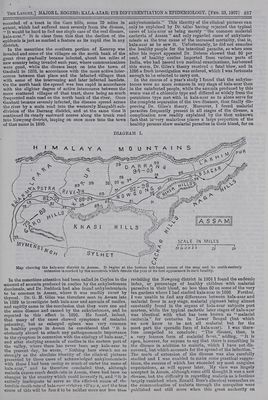
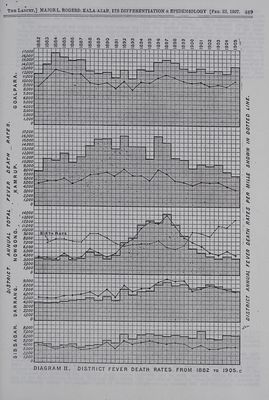
![{HE LANCET,] MAJORL. ROGERS: KALA-AZAR: ITS DIFFERENTIATION & EPIDEMIOLOGY. [Fer. 23, 1907] 487 i aeeobapine oon ncme see iS ep SPL SPE OA PPT SAE PIER EE DOP EMESIS RATA ESRI AD IAL RADON ATSC NERY ORGS BEE ERE TTL A ILL ALE CED EA LLLP IRE REECE NE TALENTED EEL th PREG AE RE EAE IEEE LAE TELE APOE RT ees pens. > -'7-nih SSA Se samme RRS Son 9 aac RNa <= pT hc Ra i ER a eR em a ee ee arnaaS recorded of a tract in the Garo hills, some 70 miles in| ankylostomiasis.” This identity of the clinical pictures can extent, which had suffered most severely from the disease, | only be explained by Dr. Giles having rejected the typical «‘[t would be hard to find one single case of the real disease, | cases of kala-azar as being merely ‘‘the common malarial kala-azar.” It is clear from this that the decline of the | cachexia of Assam” and only regarded cases of ankylosto- epidemic is just as marked a feature as its rapid rise in any | miasis as the true cause of the increased mortality, that is, district. kala-azar as he saw it. Unfortunately, he did not examine In the meantime the southern portion of Kamrup was | the healthy people for the intestinal parasite, so when soon jnvaded and some of the villages on the north bank of the | after his report appeared Dr. Dobson showed that 80 per great river gradually became infected, about ten miles of | cent. of healthy coolies imported from various parts of new country being invaded each year, where communications | India, who had passed two medical examinations, harboured were good, while the disease leapt on into the town of/| this worm, Dr. Giles’s theory received a fatal blow, and in Gauhati in 1888, in accordance with the more active inter- | 1896 a fresh investigation was ordered, which I was fortunate course between that place and the infected villages than | enough to be selected to carry out. with some of the intervening and later infected hamlets. In the course of a year’s study I found that the ankylos- On the north bank the spread was less rapid in accordance | tomes were no more common in any stage of kala-azar than with the slighter degree of active intercourse between the | in the uninfected people, while the anwmia produced by this more scattered villages of that tract, there being no much | worm was of a chlorotic type and differed so widely from the frequented main road on the north bank of the river. Once | pernicious type met with in kala-azar as to alone serve for Gaubati became severely infected, the disease spread across | the complete separation of the two diseases, thus finally dis- the river by a main road into the westernly Mangaldi sub- proving Dr. Giles’s theory. Moreover, I found malarial division of the Darrang district, and at the same time it | parasites frequently present in all stages of the disease, a continued its steady eastward course along the trunk road | complication now readily explained by the then unknown into Nowgong district, leaping on once more into the town | fact that in'very malarious places a large proportion of the of that name in 1890. i healthy persons show malarial parasites in their blood, for on DIAGRAM Il. ple DB MM aoe eet ay Ae err -2 % Bhs tae Act AG. Yn A La TA NS 2 va be ir Por - % Me Se 7 - ot i) regi OLA on ® we = Sa ae Me caus ply EE ee. Ne amzing, Stated ¢ ~ = te pe : gto” er * en Laces artic Ao Ne NS SCE icant eee pe SS, ee RT ey aS Ue a ~s.-? eS 398 ~--- as aR AL ‘ on ¢ - R : A ‘ “ ’ D A NG ies ea f Q 0 ; v : ~) : : : : ¥ anaes > ’ Cae wetter --- Poe Sain, Vaan, t Sa-—6 “.s SCALE IN MILES \ eee sah ' Negake: Chl i) ulalckee aa. | clean kt S] i ; 25 20 1510 5 0 25 50 w= eee ~ ~ Map showing the kala-azar district in Assam. It begins at the bottom left-hand corner of the map and its north-easterly extension is marked by the numerals which denote the year of its first appearance in each locality. amount of anwmia produced in coolies by the ankylostomum | index, or percentage of healthy children with malarial duodenale, and Dr. Ruddock had also found ankylostomiasis | parasites in their blood, no less than 80 on some of the very to be common in Assam, where it was readily cured by | tea gardens where I had studied kala-azar in 1896. Further, thymol. Dr. G. M. Giles was therefore sent to Assam late | I was unable to find any differences between kala-azar and in 1889 to investigate both kala-azar and anemia of coolies, | malarial fever in any stage, malarial pigment being almost and rapidly came to the conclusion that they were one and | constantly found in the organs of kala-azar subjects post the same disease and caused by the ankylostomes, and he | mortem, while the typical cachetic later stages of kala-azar reported to this effect in 1890. He found, indeed, | was identical with what has been known as ‘‘ malarial that many of the cases showed symptoms of malarial | cachexia” for centuries in Lower Bengal (but which poisoning, but as enlarged spleen was very common/we now know to be not all malarial but for the malaria causes much death-rate in Assam, there had been no | accepted in Assam, although some still thought it was a new changes in the country which could intensify it, and ‘‘it is | disease, but the difficulty in regarding malaria as ir fectious entirely inadequate to serve as the efficient cause of the | largely vanished when Rovald Ross’s classical researches on terrible death-rate of kala-azar stricken villaz s, and the true | the communication of malaria through the mosquitos were cause of this will be fourd to be neither more nor less than ! published and still more when this great authority on In the meantime attention had been called in Ceylon to the | revisiting the Nowgong district in 1904 I found the endemic {](https://iiif.wellcomecollection.org/image/b33450523_0007.jp2/full/800%2C/0/default.jpg)