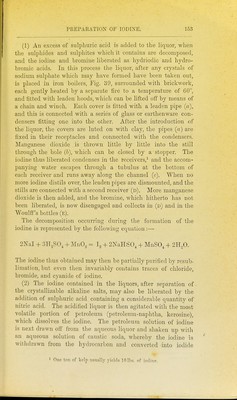
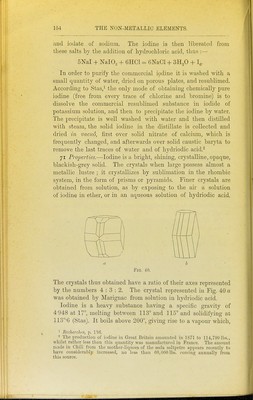
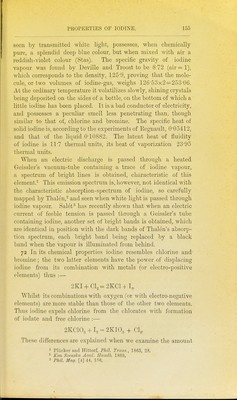
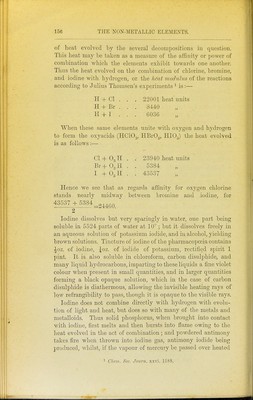
A treatise on chemistry. Vol. 1, The non-metallic elements / by Sir H.E. Roscoe & C. Schorlemmer ...
- Henry Enfield Roscoe
- Date:
- 1881
Licence: Public Domain Mark
Credit: A treatise on chemistry. Vol. 1, The non-metallic elements / by Sir H.E. Roscoe & C. Schorlemmer ... Source: Wellcome Collection.
Provider: This material has been provided by University of Bristol Library. The original may be consulted at University of Bristol Library.
173/792 (page 157)
![iodine, immediate action occurs, the iodides of mercury being formed. Wlien iodine is brought into contact with water and filings of iron or zinc, a violent reaction occurs, colourless solu- tions of the respective iodides resulting. The action of iodine upon the alkali-metals is analogous to that of chlorine and bromine. Sodium and iodine can be heated together without any alteration, whilst if potassium be employed an explosive combination occurs. Potash at once decolorizes a solution of iodine, iodide and iodate of potassium being produced, thus :— 61 + 6KH0 = 5KI + KIO.5 + Snp. When acted upon by strong nitric acid, iodine is completely oxidized to iodic acid HIO3. The most characteristic property of free iodine is its power of forming a splendid blue colour with starch-paste. This is formed when starch granules are brought into contact with the vapom' of iodine, or, better, when, a solution of iodine is added to starch-paste. The blue colour disappears on warming the solution, but reappears on cooling, and its formation serves as a most delicate test for the presence of iodine.^ In order to exhibit this property, a few grains of iodide of potassium may be dissolved in three or four litres of water placed in a large glass cylinder, and some clear, dilute, well boiled starch-paste added. As the iodine is here combined with the metal no coloration will be seen, but if a few drops of chlorine water be added, or, better, if a little of the air (containing free chlorine) from a bottle of chlorine water be poured on to the surface of the liquid, a blue film will be formed, which on stirring will impart a blue tint to the whole mass. Iodine both free and in combination is largely used in medicine. ^ Collin and Gaultier de Claubry, Ann. Chim. 90, 87. [Note on the Abnormal Density of Iodine Vapour,—Victor Meyer (Ber. BeutscK. Chcm. Ges. xiii. 394), as well as F. Meier and Crafts {Jbid. 851), have shown that the vapour density of Iodine although normal at temperatures below 700° diminislies at a higher temperature. Thus at 1890° it is only 0-60 of the theoretical density. The full discussion of this remarkable fact must be reserved for the chapter on Tlieoretical Chemistry.]](https://iiif.wellcomecollection.org/image/b21449016_0173.jp2/full/800%2C/0/default.jpg)