A treatise on chemistry. Vol. 1, The non-metallic elements / by Sir H.E. Roscoe & C. Schorlemmer ...
- Henry Enfield Roscoe
- Date:
- 1881
Licence: Public Domain Mark
Credit: A treatise on chemistry. Vol. 1, The non-metallic elements / by Sir H.E. Roscoe & C. Schorlemmer ... Source: Wellcome Collection.
Provider: This material has been provided by University of Bristol Library. The original may be consulted at University of Bristol Library.
200/792 (page 184)
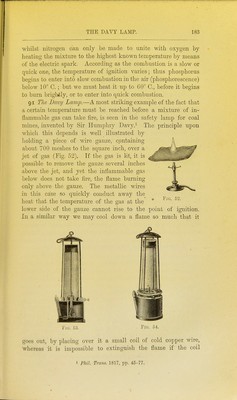
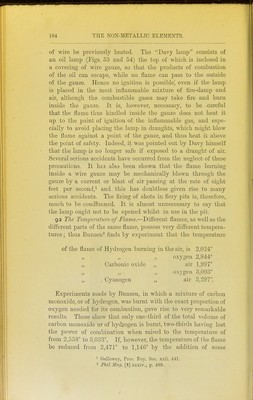
![of wire be previously heated. The Davy lamp consists of an oil lamp (Figs. 53 and 54) the top of which is inclosed in a covering of wire gauze, so that the products of combustion of the oil can escape, while no flame can pass to the outside of the gauze. Hence no ignition is possiblej even if the lamp is placed in the most inflammable mixture of tire-damp and air, although the combustible gases may take fire and burn inside the gauze. It is, however, necessary, to be careful that the flame thus kindled inside the gauze does not heat it up to the point of ignition of the inflammable gas, and espe- cially to avoid placing the lamp in draughts, which might blow the flarae against a point of the ganze, and thus heat it above the point of safety. Indeed, it was pointed out by Davy himself that the lamp is no longer safe if exposed to a draught of air. Several serious accidents have occurred from the neglect of these precautions. It has also been shown that the flame burning inside a wire gauze may be mechanically blown through the gauze by a current or blast of air passing at the rate of eight feet per second,^ and this has doubtless given rise to many serious accidents. The firing of shots in fiery pits is, therefore, much to be condemned. It is almost unnecessary to say that the lamp ought not to be opened whilst in use in the pit. 92 The Temperature of Flame.—Different flames, as well as the different parts of the same flame, possess very different tempera- tures ; thus Bunsen^ finds by experiment that the temperature of the flame of Hydrogen burning in the air, is 2,024° oxygen 2,844° air 1,997° oxygen 3,003° air 3,297°. Experiments made by Bunsen, in which a mixture of carbon monoxide, or of hydrogen, was burnt with l.he exact proportion of oxygen needed for its combustion, gave rise to very remarkable results. These show that only one-third of the total volume of carbon monoxide or of hydj'Ogen is burnt, two-thirds haviug lost the power of combination when raised to the temperature of from 2,558° to 3,033°. If, however, the temperature of the flame bo reduced from 2,471° to 1,146° by the addition of some ' Galloway, Proa Poy. Soc. x.xii. 441. 2 Phil Mag. [4] xxxiv., p. 489. 5> Carbonic oxide Cyanogen](https://iiif.wellcomecollection.org/image/b21449016_0200.jp2/full/800%2C/0/default.jpg)