A treatise on chemistry. Vol. 1, The non-metallic elements / by Sir H.E. Roscoe & C. Schorlemmer ...
- Henry Enfield Roscoe
- Date:
- 1881
Licence: Public Domain Mark
Credit: A treatise on chemistry. Vol. 1, The non-metallic elements / by Sir H.E. Roscoe & C. Schorlemmer ... Source: Wellcome Collection.
Provider: This material has been provided by University of Bristol Library. The original may be consulted at University of Bristol Library.
717/792 (page 701)
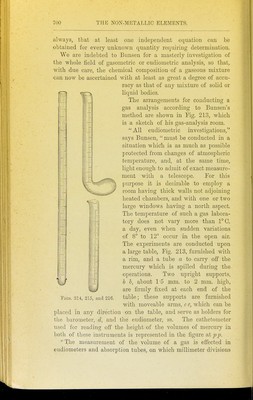
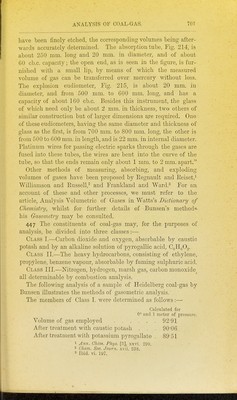
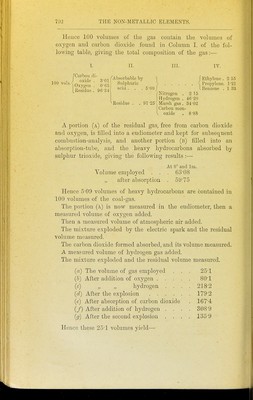
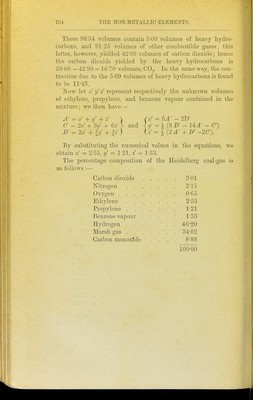
![have been finely etched, the corresponding volumes being after- wards accurately determined. The absorption tube, Tig. 214, is about 250 mm. long and 20 mm. in diameter, and of about 60 cb.c. capacity; tlie open end, as is seen in the figure, is fur- nished with a small lip, by means of which the measured volume of gas can be transferred over mercury without loss. The explosion eudiometer, Fig. 215, is about 20 mm. in diameter, and from 500 mm. to 600 mm. long, and has a capacity of about 160 cb.c. Besides this instrument, the glass of which need only be about 2 mm. in thickness, two others of similar construction but of larger dimensions aje required. One of these eudiometers, having the same diameter and thickness of glass as the first, is from 700 mm. to 800 mm. long, the other is from 500 to 600 mm. in length, and is 22 mm. in internal diameter. Platinum wires for passing electric sparks through the gases are fused into these tubes, the wires are bent into the curve of the tube, so that the ends remain only about 1 mm. to 2 mm. apart. Other methods of measuring, absorbing, and exploding volumes of gases have been proposed by Eegnault and Eeiset,^ Williamson and Paissell,^ and Frankland and Ward.^ For an account of these and other processes, we must refer to the article. Analysis Volumetric of Gases in Watts's Dictionary of Chemistry, whilst for further details of Bunsen's method«^ his Gasometry may be consulted. 447 The constituents of coal-gas may, for the purposes of analysis, be divided into three classes:— Class T.—Carbon dioxide and oxygen, absorbable by caustio potash and by an alkaline solution of pyrogallic acid, CflHgOg. Class IT.—The heavy hydrocarbons, consisting of ethylene, propylene, benzene vapour, absorbable by fuming sulphuric acid. Class III.—Nitrogen, hydrogen, marsh gas, carbon monoxide^ all determinable by combustion analysis. The following analysis of a sample of Heidelberg coal-gas by Bunsen illustrates the methods of gasometric analysis. The members of Class I. were determined as follows:— Calculated for 0 and 1 meter of pressure. Volume of gas employed 92-91 After treatment with caustic potash . . . 90'06 After treatment with potassium pyrogallate . 89 51 1 Ann. Chim. Phys. [.*?], xxvi. 299. ^ Chem. Soc. Journ. xvii. 238. ' Ibid. vi. 197.](https://iiif.wellcomecollection.org/image/b21449016_0717.jp2/full/800%2C/0/default.jpg)