Handbook on contagious and infectious diseases in animals / issued by the Quartermaster General's Branch, Army Headquarters, India.
- Date:
- 1936
Licence: Attribution 4.0 International (CC BY 4.0)
Credit: Handbook on contagious and infectious diseases in animals / issued by the Quartermaster General's Branch, Army Headquarters, India. Source: Wellcome Collection.
35/488 page 23
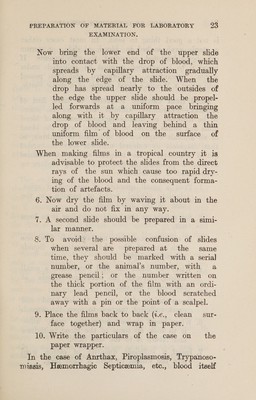
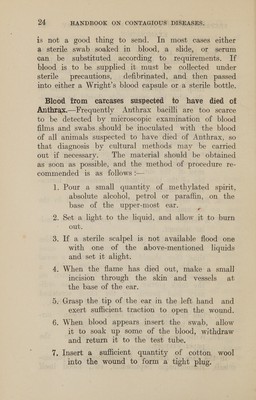
![EXAMINATION. Now bring the lower end of the upper slide into contact with the drop of blood, which spreads by capillary attraction gradually along the edge of the slide. When the drop has spread nearly to the outsides of the edge the upper slide should be propel- led forwards at a uniform pace bringing along with it by capillary attraction the drop of blood and leaving behind a thin uniform film of blood on the surface of the lower slide. When making films in a tropical country it is advisable to protect the slides from the direct rays of the sun which cause too rapid dry- ing of the blood and the consequent forma- tion of artefacts. 6. Now dry the film by waving it about in the air and do not fix in any way. 7. A second slide should be prepared in a simi- lar manner. 8. To avoid’ the possible confusion of slides when several are prepared at the same time, they should be marked with a serial] number, or the animal’s number, with a grease pencil; or the number written on the thick portion of the film with an ordi- nary lead pencil, or the blood scratched away with a pin or the poimt of a scalpel. 9. Place the films back to back (¢.e., clean sur- face together) and wrap in paper. 10. Write the particulars of the case on the paper wrapper. In the case of Anrthax, Piroplasmosis, Trypanoso- miasis, Hemorrhagic Septicemia, etc., blood itself](https://iiif.wellcomecollection.org/image/b32174305_0035.jp2/full/800%2C/0/default.jpg)
 No text description is available for this image
 No text description is available for this image
 No text description is available for this image