[Report 1971] / Medical Officer of Health, Kingston-upon-Hull County Borough.
- Hull (England). County Borough Council.
- Date:
- 1971
Licence: Attribution 4.0 International (CC BY 4.0)
Credit: [Report 1971] / Medical Officer of Health, Kingston-upon-Hull County Borough. Source: Wellcome Collection.
108/172 page 102
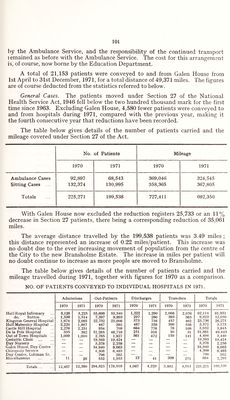
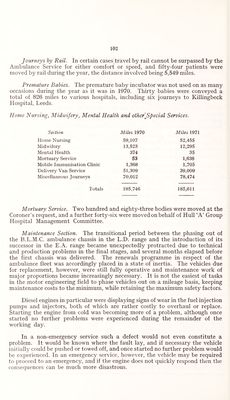
![Journeys by Rail. In certain cases travel by rail cannot be surpassed by the Ambulance Service for either comfort or speed, and fifty-four patients were moved by rail during the year, the distance involved being 5,549 miles. Premature Babies. The premature baby incubator was not used on as many occasions during the year as it was in 1970. Thirty babies were conveyed a total of 826 miles to various hospitals, including six journeys to Killingbeck Hospital, Leeds. Home Nursing, Midwifery, Mental Health and other]Special Services. Section Home Nursing Midwifery Mental Health Mortuary Service Mobile Immunisation Clinic Delivery Van Service Miscellaneous Journeys Totals Miles 1970 Miles 1971 59,107 52,455 13,523 12,295 374 35 53 1,638 1,368 1,705 51,309 39,009 70,012 78,474 195,746 185,611 Mortuary Service. Two hundred and eighty-three bodies were moved at the Coroner's request, and a further forty-six were moved on behalf of Hull ‘A’ Group Hospital Management Committee. Maintenance Section. The transitional period between the phasing out of the B.L.M.C. ambulance chassis in the L.D. range and the introduction of its successor in the E.A. range became unexpectedly protracted due to technical and production problems in the final stages, and several months elapsed before the first chassis was delivered. The renewals programme in respect of the ambulance fleet was accordingly placed in a state of inertia. The vehicles due for replacement, however, were still fully operative and maintenance work of major proportions became increasingly necessary. It is not the easiest of tasks in the motor engineering field to phase vehicles out on a mileage basis, keeping maintenance costs to the minimum, while retaining the maximum safety factors. Diesel engines in particular were displaying signs of wear in the fuel injection pumps and injectors, both of which are rather costly to overhaul or replace. Starting the engine from cold was becoming more of a problem, although once started no further problems were experienced during the remainder of the working day. In a non-emergency service such a defect would not even constitute a problem. It would be known where the fault lay, and if necessary the vehicle initially could be pushed or towed off, and once started no further problem would be experienced. In an emergency service, however, the vehicle may be required to proceed to an emergency, and if the engine does not quickly respond then the consequences can be much more disastrous.](https://iiif.wellcomecollection.org/image/b29441560_0108.jp2/full/800%2C/0/default.jpg)
 No text description is available for this image
 No text description is available for this image
 No text description is available for this image