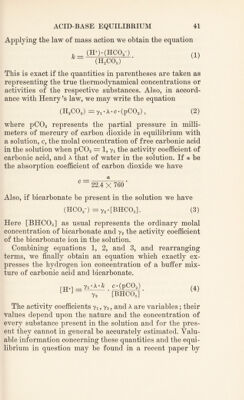
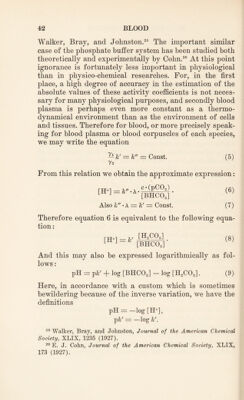
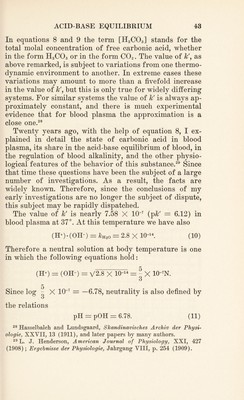
Blood : a study in general physiology / by Lawrence J. Henderson.
- Lawrence Joseph Henderson
- Date:
- 1928
Licence: In copyright
Credit: Blood : a study in general physiology / by Lawrence J. Henderson. Source: Wellcome Collection.
71/434 page 45
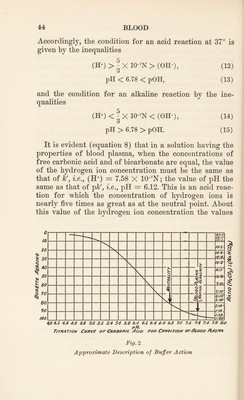
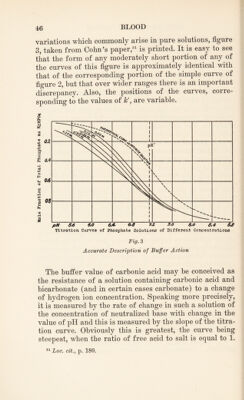
![for solutions containing mixtures of carbonic acid and bi¬ carbonate vary symmetrically as the relative concentra¬ tions of the two substances change. Thus if the ratio be 1: 2 the hydrogen ion concentration becomes 3.79 X10⁻⁷N; if the ratio be 2:1, 15.2 X 10~7N; if the ratio be 1:10, 7.58 X l(h8N; if the ratio be 10:1, 7.58 X 10~6N. In figure 2, corresponding to the well-known titration curves of physical chemistry, these conditions are com¬ pletely illustrated. For convenience hydrogen ion concen¬ tration is represented logarithmically by values of pH as abscissas. The ordinates represent the readings of a bu¬ rette from which sodium hydroxide solution is being de¬ livered to a solution originally containing free carbonic acid but no bicarbonate, which is assumed to possess and to preserve the properties of blood plasma. Values of the ratio [H2C03] [BHCOa] are also represented as ordinates. While this curve is quite as accurate a representative of the facts of the equilibrium in blood plasma as is now possi¬ ble, and probably very accurate indeed, it must be borne in mind that in a more simple solution, such as a pure solution of carbonic acid, the value of k' is bound to vary sensibly on account of variation in the activity coefficients of the substances involved in the reaction. Such varia¬ tions will depend especially upon changes of the ionic strength of the solution. In such cases the curve suffers systematic deformation. The nature of the case in solu¬ tions of phosphates has been completely worked out in the above-mentioned memoir of Cohn,30 who has shown that the Debye-Hiickel theory of ionization may be suc¬ cessfully applied. In order to illustrate the departure from the simple ap¬ proximate equation of acid-base equilibrium (equation 8) which is to be expected when the conditions are not con¬ stant, as they are in blood plasma, and are subject to the 30 E. J. Cohn, Journal of the American Chemical Society, XLIX, 173 (1927).](https://iiif.wellcomecollection.org/image/b29928771_0071.jp2/full/800%2C/0/default.jpg)
 No text description is available for this image
 No text description is available for this image
 No text description is available for this image