Blood : a study in general physiology / by Lawrence J. Henderson.
- Lawrence Joseph Henderson
- Date:
- 1928
Licence: In copyright
Credit: Blood : a study in general physiology / by Lawrence J. Henderson. Source: Wellcome Collection.
75/434 page 49
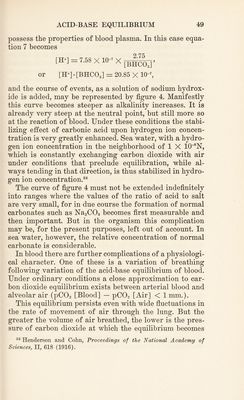
![possess the properties of blood plasma. In this case equa¬ tion 7 becomes 9 7^ [H*] = 7.58 x 10⁻⁷ x [BncOa]’ or [H+] • [BHC03] = 20.85 X 10⁻⁷, and the course of events, as a solution of sodium hydrox¬ ide is added, may be represented by figure 4. Manifestly this curve becomes steeper as alkalinity increases. It is already very steep at the neutral point, but still more so at the reaction of blood. Under these conditions the stabi¬ lizing effect of carbonic acid upon hydrogen ion concen¬ tration is very greatly enhanced. Sea water, with a hydro¬ gen ion concentration in the neighborhood of 1 X 10~8N, which is constantly exchanging carbon dioxide with air under conditions that preclude equilibration, while al¬ ways tending in that direction, is thus stabilized in hydro¬ gen ion concentration.33 The curve of figure 4 must not be extended indefinitely into ranges where the values of the ratio of acid to salt are very small, for in due course the formation of normal carbonates such as Na2C03 becomes first measurable and then important. But in the organism this complication may be, for the present purposes, left out of account. In sea water, however, the relative concentration of normal carbonate is considerable. In blood there are further complications of a physiologi¬ cal character. One of these is a variation of breathing following variation of the acid-base equilibrium of blood. Under ordinary conditions a close approximation to car¬ bon dioxide equilibrium exists between arterial blood and alveolar air (pC02 [Blood] — pC02 [Air] < 1 mm.). This equilibrium persists even with wide fluctuations in the rate of movement of air through the lung. But the greater the volume of air breathed, the lower is the pres¬ sure of carbon dioxide at which the equilibrium becomes 33 Henderson and Cohn, Proceedings of the National Academy of Sciences, II, 618 (1916).](https://iiif.wellcomecollection.org/image/b29928771_0075.jp2/full/800%2C/0/default.jpg)
 No text description is available for this image
 No text description is available for this image
 No text description is available for this image