Blood : a study in general physiology / by Lawrence J. Henderson.
- Lawrence Joseph Henderson
- Date:
- 1928
Licence: In copyright
Credit: Blood : a study in general physiology / by Lawrence J. Henderson. Source: Wellcome Collection.
80/434 page 54
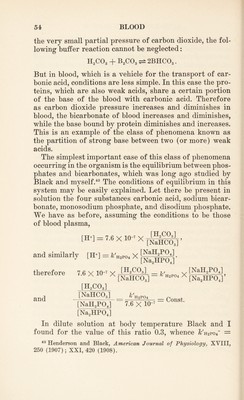
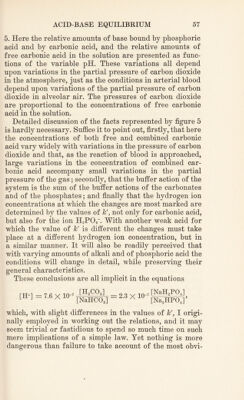
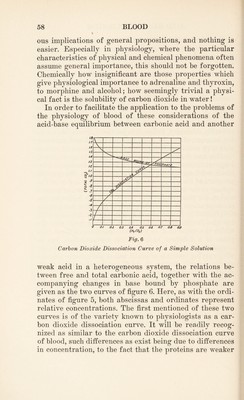
![the very small partial pressure of carbon dioxide, the fol¬ lowing buffer reaction cannot be neglected: H2C03 + B2C03 2BHC03. But in blood, which is a vehicle for the transport of car¬ bonic acid, conditions are less simple. In this case the pro¬ teins, which are also weak acids, share a certain portion of the base of the blood with carbonic acid. Therefore as carbon dioxide pressure increases and diminishes in blood, the bicarbonate of blood increases and diminishes, while the base bound by protein diminishes and increases. This is an example of the class of phenomena known as the partition of strong base between two (or more) weak acids. The simplest important case of this class of phenomena occurring in the organism is the equilibrium between phos¬ phates and bicarbonates, which was long ago studied by Black and myself.43 The conditions of equilibrium in this system may be easily explained. Let there be present in solution the four substances carbonic acid, sodium bicar¬ bonate, monosodium phosphate, and disodium phosphate. We have as before, assuming the conditions to be those of blood plasma, [H+] = 7.6 X 10⁻⁷ X [H2co3] [NaHC03] ’ and similarly [H+] - &'h2P04 X [NaH2P04] [Na2HPOJ ’ therefore and 7.6 X 10⁻⁷ X [H2CQ3] [NaHC03] W H2PO4 X [H2co3] [NaIIC03] [NaII2P04] b> H2PO4 7.6 X 10-7 = Const. [NaH2P04] [Na2HP04]’ [Na2HP04] In dilute solution at body temperature Black and I found for the value of this ratio 0.3, whence k H2PO4 — 43 Henderson and Black, American Journal of Physiology, XVIII, 250 (1907); XXI, 420 (1908).](https://iiif.wellcomecollection.org/image/b29928771_0080.jp2/full/800%2C/0/default.jpg)
 No text description is available for this image
 No text description is available for this image
 No text description is available for this image