Blood : a study in general physiology / by Lawrence J. Henderson.
- Lawrence Joseph Henderson
- Date:
- 1928
Licence: In copyright
Credit: Blood : a study in general physiology / by Lawrence J. Henderson. Source: Wellcome Collection.
83/434 page 57
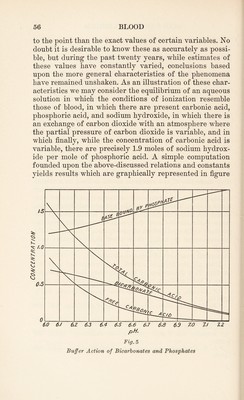
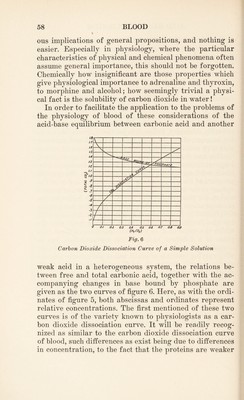
![5. Here the relative amounts of base bound by phosphoric acid and by carbonic acid, and the relative amounts of free carbonic acid in the solution are presented as func¬ tions of the variable pH. These variations all depend upon variations in the partial pressure of carbon dioxide in the atmosphere, just as the conditions in arterial blood depend upon variations of the partial pressure of carbon dioxide in alveolar air. The pressures of carbon dioxide are proportional to the concentrations of free carbonic acid in the solution. Detailed discussion of the facts represented by figure 5 is hardly necessary. Suffice it to point out, firstly, that here the concentrations of both free and combined carbonic acid vary widely with variations in the pressure of carbon dioxide and that, as the reaction of blood is approached, large variations in the concentration of combined car¬ bonic acid accompany small variations in the partial pressure of the gas; secondly, that the buffer action of the system is the sum of the buffer actions of the carbonates and of the phosphates; and finally that the hydrogen ion concentrations at which the changes are most marked are determined by the values of k', not only for carbonic acid, but also for the ion H2P04~. With another weak acid for which the value of k' is different the changes must take place at a different hydrogen ion concentration, but in a similar manner. It will also be readily perceived that with varying amounts of alkali and of phosphoric acid the conditions will change in detail, while preserving their general characteristics. These conclusions are all implicit in the equations [H+] = 7.6 X 10⁻⁷ [H2CQ3] [NaHCOg] = 2.3 X 10⁻⁷ [NaH2P04] [Na2HP04]’ which, with slight differences in the values of kr, I origi¬ nally employed in working out the relations, and it may seem trivial or fastidious to spend so much time on such mere implications of a simple law. Yet nothing is more dangerous than failure to take account of the most obvi-](https://iiif.wellcomecollection.org/image/b29928771_0083.jp2/full/800%2C/0/default.jpg)
 No text description is available for this image
 No text description is available for this image
 No text description is available for this image