Blood : a study in general physiology / by Lawrence J. Henderson.
- Lawrence Joseph Henderson
- Date:
- 1928
Licence: In copyright
Credit: Blood : a study in general physiology / by Lawrence J. Henderson. Source: Wellcome Collection.
90/434 page 64
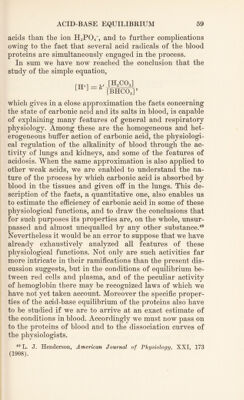
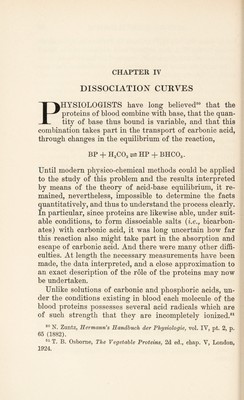
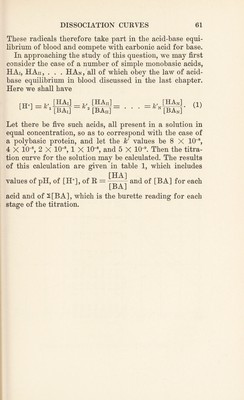
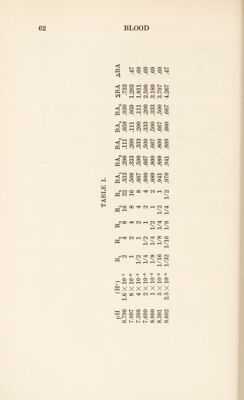
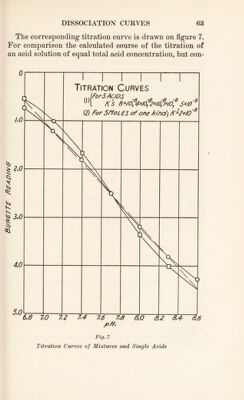
![taining only one acid, for which fc' = 2X 10~8, is given. It will be seen that the characteristic S-shape of the latter curve is much modified in the titration curve of the mix¬ ture of acids. This curve, throughout a wide range of values of pH, roughly approximates to a straight line. In general such composite titration curves, represent¬ ing the overlapping buffer actions of several acid radi¬ cals, are relatively straight and often very nearly so, through a considerable range of hydrogen ion concentra¬ tion. They possess minor sinuosities, according to the number and magnitudes of the different values of k' which are involved. But under favorable circumstances and for ranges of hydrogen ion concentration that are not very large, say ApH < 1.5, a satisfactory approximation to a 4 linear relation between values of 2 [BA] and values of pH may be often expected. As conditions become more complex, the validity of the simplifying assumptions which are implicit in the present theoretical discussions becomes increasingly uncertain.52 Accordingly the application of this last result to the poly- basic protein molecule presents theoretical difficulties. Nevertheless it is a fact that the titration curves of pro¬ teins, as experimentally determined, possess the charac¬ teristics that have just been described. As an example of the experimentally determined behavior of a protein we may take measurements of the titration curve of serum albumin.53 Throughout a range of reaction equal to that represented by figure 7 the titration curve is nearly a straight line. The behavior of the proteins of blood as acids binding base has been measured by Van Slyke, Wu, and McLean54 and by Hastings and Harington.65 They find that within 52 E. J. Cohn, Physiological Reviews, V, 376 (1925). 53 Ibid., p. 380 (1925). 54 Van Slyke, Wu, and McLean, Journal of Biological Chemistry, LVI, 765 (1923). 55 Hastings, Van Slyke, Neill, Heidelberger, and Harington, Journal of Biological Chemistry, LX, 89 (1924).](https://iiif.wellcomecollection.org/image/b29928771_0090.jp2/full/800%2C/0/default.jpg)
 No text description is available for this image
 No text description is available for this image
 No text description is available for this image