Blood : a study in general physiology / by Lawrence J. Henderson.
- Lawrence Joseph Henderson
- Date:
- 1928
Licence: In copyright
Credit: Blood : a study in general physiology / by Lawrence J. Henderson. Source: Wellcome Collection.
92/434 page 66
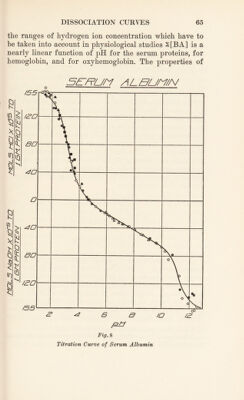
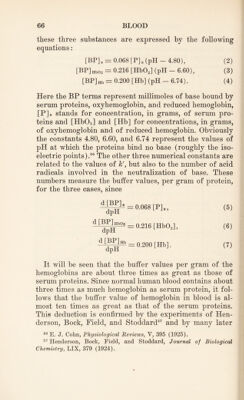
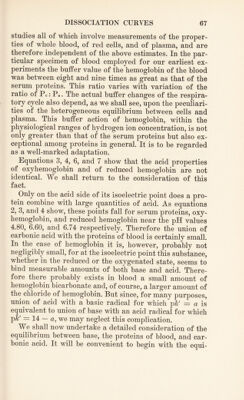
![these three substances are expressed by the following equations: [BP]S — 0.068 [P]s (pH - 4.80), (2) [BP]Hbo2 = 0.216 [Hb02] (pH - 6.60), (3) [BP]Hb = 0.200 [Hb] (pH - 6.74). (4) Here the BP terms represent millimoles of base bound by serum proteins, oxyhemoglobin, and reduced hemoglobin, [P]s stands for concentration, in grams, of serum pro¬ teins and [Hb02] and [Hb] for concentrations, in grams, of oxyhemoglobin and of reduced hemoglobin. Obviously the constants 4.80, 6.60, and 6.74 represent the values of pH at which the proteins bind no base (roughly the iso¬ electric points).56 The other three numerical constants are related to the values of k', but also to the number of acid radicals involved in the neutralization of base. These numbers measure the buffer values, per gram of protein, for the three cases, since d [BP]S dpH d [BP] Hb02 dpH d [BP]Hb dpH = 0.068 [P]s, = 0.216 [HbOJ, = 0.200 [Hb]. (5) (6) (7) It will be seen that the buffer values per gram of the hemoglobins are about three times as great as those of serum proteins. Since normal human blood contains about three times as much hemoglobin as serum protein, it fol¬ lows that the buffer value of hemoglobin in blood is al¬ most ten times as great as that of the serum proteins. This deduction is confirmed by the experiments of Hen¬ derson, Bock, Field, and Stoddard57 and by many later 56 E. J. Cohn, Physiological Reviews, V, 395 (1925). 57 Henderson, Bock, Field, and Stoddard, Journal of Biological Chemistry, LIX, 379 (1924).](https://iiif.wellcomecollection.org/image/b29928771_0092.jp2/full/800%2C/0/default.jpg)
 No text description is available for this image
 No text description is available for this image
 No text description is available for this image