Elements of human physiology / by L. Hermann ; translated from the sixth edition by Arthur Gamgee.
- Gamgee Arthur, 1841-1909.
- Date:
- 1878
Licence: Public Domain Mark
Credit: Elements of human physiology / by L. Hermann ; translated from the sixth edition by Arthur Gamgee. Source: Wellcome Collection.
Provider: This material has been provided by the Royal College of Physicians of Edinburgh. The original may be consulted at the Royal College of Physicians of Edinburgh.
42/620 (page 22)
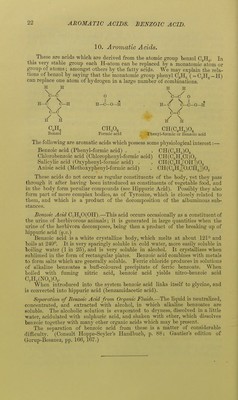
![AROMATIC ACIDS. BENZOIC ACID. 10. Aromatic Acids. _ These are acids whicli are derived from the atomic group benzol G^\. In this very stable gi-oup each H-atom can be replaced by a monatomic atom or group of atoms; amongst others by the fatty acids. We may explain the rela- tions of benzol by saying that the monatomic gi'oup phenyl ( = CaHg-H) can replace one atom of hydrogen in a large niunber of combinations. H H 0 ^j-c'^ 0 II » / S II • H—C-O-H , H-C C—C—0-H \ / c=c / \ Formic acid Phenyl-formic or Benzoic acid The following are aromatic acids which possess some physiological interest:— Benzoic acid (Phenyl-formic acid) . . , CH(CgB[5)0j Chlorobenzoic acid (Ohlorophenyl-formic acid) CH(0gH^01)O2 Salicylic acid (Oxyphenyl-lormic acid) . . OH(CgH4[OH:j)02 Anisic acid (Methoxyphenyl-formic acid) . OH(06H,[O.OH3])02 These acids do not occur as regular constituents of the body, yet they pass through it after having been introduced as constituents of vegetable food, and in the body form peculiar compounds (see Hippuric Acid). Possibly they also form part of more complex bodies, as of Tyrosine, which is closely related to them, and which is a product of the decomposition of the albuminous sub- stances. Benzoic Acid 0,H50(0H).—This acid occurs occasionally as a constituent of the urine of herbivorous animals; it is generated in large quantities when the mine of the herbivora decomposes, being then a product of the breaking up of hippuric acid {q.v.) Benzoic acid is a white crystalline body, which melts at about 121° and boils at 249°. It is very sparingly soluble in cold water, more easily soluble in boiling water (1 in 25), and is very soluble in alcohol. It crystallizes when sublimed in the form of rectangular plates. Benzoic acid combines with metals to form salts which are generally soluble. Ferric chloride produces in solutions of alkaline benzoates a buff-coloured precipitate of ferric benzoate. When boiled with fuming nitric acid, benzoic acid yields nitro-benzoic acid 0,H,(NO,)0„. When introduced into the system benzoic acid links itself to glycine, and is converted into hippuric acid (benzamidacetic acid). Separation of Benzoic Acid from Orfjanic Fluids.—The liquid is neutralized, concentrated, and extracted with alcohol, in which alkaline benzoates are soluble. The alcoholic solution is evaporated to drj-ness, dissolved in a little water, acidulated with sulphuric acid, and shaken with ether, which dissolves benzoic together with many other organic acids which may be present. The separation of benzoic acid from these is a matter of considerable difficulty. (Consult Hoppe-Seyler's Ilandbuch, p. 88; Gautier's edition of Gorup-Besanez, pp. 166, 167.) H H ^ ^ ^ H—C C—H \ / c=c / ^ Benzol](https://iiif.wellcomecollection.org/image/b21725366_0042.jp2/full/800%2C/0/default.jpg)