Absorption and metabolism in obstruction of the pancreatic duct / by Vaughan Harley.
- Vaughan Harley
- Date:
- 1895
Licence: Public Domain Mark
Credit: Absorption and metabolism in obstruction of the pancreatic duct / by Vaughan Harley. Source: Wellcome Collection.
Provider: This material has been provided by The Royal College of Surgeons of England. The original may be consulted at The Royal College of Surgeons of England.
9/18 page 7
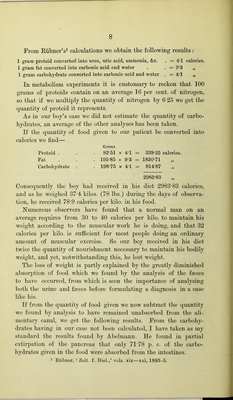
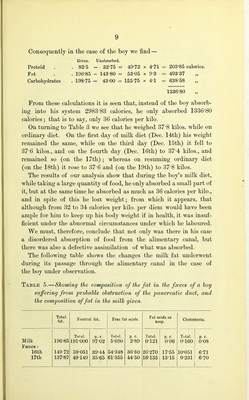
![tary canal I will compare the average results of these two days with that found by Eubuer^ in a healthy man on a milk diet. Table 4.—Comparing the quantity of nitrogen and fat absorbed from the alimentary canal on milk diet in a healthy man (Rubner) and the patient suffering from probable obstruction to the pan- creatic duct. Conditiou. Milk contained Faeces contained Absorbed. Quan- tity. c.c. N. Grams. Fat. Grams. N Grms. % Fat. Grams. % N. Grams. % Fat. Grams. % Health 3075 19-4 119-9 1-5 7-7 6-7 5-6 17-9 92-3 112-9 94-4 Pancreatic obstruction 3976 13-12 196-85 5*25 dO-0 143-80 CO 6 7-87 60-0 52-05 26-95 In Table 4 it is seen that in the healthy man the faeces contained 1'5 grams of nitrogen, i. e. 7'7 per cent, of the total nitrogen given, consequently 92'3 per cent, of the total nitrogen given had been absorbed. When we compare this with the unhealthy boy’s case it is seen that in an average of two days, during which the patient was on nitrogen equihbrium, the faeces contained 5'25 grams of nitrogen, so that 40 per cent, of the total nitrogen given was ehminated in the faeces, and 60 per cent, only had been taken into the system to be made use of in metabolism. As regards the fat, in Riibner’s healthy man only 6'7 grams were excreted in the faeces, i. e. 5’6 per cent.; whereas in our boy’s case (of probable obstruction to the pancreatic duct) the faeces contained 143'80 grams of fat, i. e. 73'05 per cent.,—so that only 26'95 per cent, of the fat given was absorbed from the intestines and rendered ca]>able of being made use of in metabolism. The two cases seem fair ones to compare, as the quantity of food given was about equal in both; the only difference being that while the boy received a larger quantity of fat in his diet, Riibner’s received a larger quantity of nitrogenous food. Turning now from what the results given in these tables show as regards absorption to the actual nourishment of our case, it may be as well to express it in the form of calories,—that is to say, the quantity of heat necessary to raise one kilogram 1° C. * Riibner, ‘ Zeit. f. Biol..’ 1879, vol. xv, p. 115.](https://iiif.wellcomecollection.org/image/b22399926_0011.jp2/full/800%2C/0/default.jpg)