Some critical remarks on Capt. Patton's Report on oriental sore / by C.M. Wenyon.
- Charles Morley Wenyon
- Date:
- [1912]
Licence: Public Domain Mark
Credit: Some critical remarks on Capt. Patton's Report on oriental sore / by C.M. Wenyon. Source: Wellcome Collection.
3/8
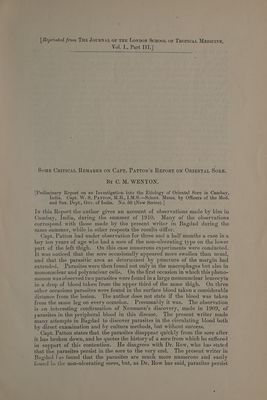
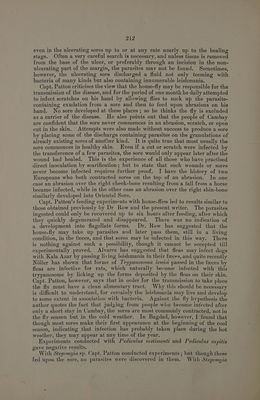
![[Leprinted from Tue JouRNAL oF THE Lonvon Scuoon or Trorivat Mxrpicine, Vol. I., Part II.] Some CriricAL REMARKS ON Capt. Patton’s Report ON ORIENTAL SorE. By C. M. WENYON. [Preliminary Report on an Investigation into the Etiology of Oriental Sore in Cambay, India. Capt. W.8. Parron, M.B., I.M.S.—Scient. Mems. by Officers of the Med. and San. Dept., Gov. of India. No. 50 (New Series). | In this Report the author gives an account of observations made by him in Cambay, India, during the summer of 1910. Many of the observations correspond with those made by the present writer in Bagdad during the same summer, while in other respects the results differ. Capt. Patton had under observation for three and a half months a case ina boy ten years of age who had a sore of the non-ulcerating type on the lower part of the left thigh. On this case numerous experiments were conducted. It was noticed that the sore occasionally appeared more swollen than usual, and that the parasitic area as determined by puncture of the margin had extended. Parasites were then found not only in the macrophages but also in mononuclear and polynuclear cells. On the first occasion in which this pheno- menon was observed two parasites were found ina large mononuclear leucocyte in a drop of blood taken from the upper third of the same thigh. On three other occasions parasites were found in the surface blood taken a considerable distance from the lesion. ‘The author does not state if the blood was taken from the saine leg on every occasion. Presumably it was. The observation is an interesting confirmation of Neumann’s discovery, made in 1909, of parasites in the peripheral blood in this disease. The present writer made many attempts in Bagdad to discover parasites in the circulating blood both by direct examination and by culture methods, but without success: Capt. Patton states that the parasites disappear quickly from the sore after it has broken down, and he quotes the history of a sore from which he suffered in support of this contention. He disagrees with Dr. Row, who has stated that the parasites persist in the sore to the very end. ‘The present writer in Bagdad 1 as found that the parasites are much more numerous and easily found in the non-ulcerating sores, but, as Dr. Row has: said, parasites persist](https://iiif.wellcomecollection.org/image/b3344030x_0003.jp2/full/800%2C/0/default.jpg)