A collection of state statutes relating to insanity in criminal cases / third report of Committee B of the American Institute of Criminal Law and Criminology.
- American Institute of Criminal Law and Criminology. Committee on Insanity and Criminal Responsibility.
- Date:
- 1913
Licence: Public Domain Mark
Credit: A collection of state statutes relating to insanity in criminal cases / third report of Committee B of the American Institute of Criminal Law and Criminology. Source: Wellcome Collection.
Provider: This material has been provided by the Harvey Cushing/John Hay Whitney Medical Library at Yale University, through the Medical Heritage Library. The original may be consulted at the Harvey Cushing/John Hay Whitney Medical Library at Yale University.
12/40 page 10
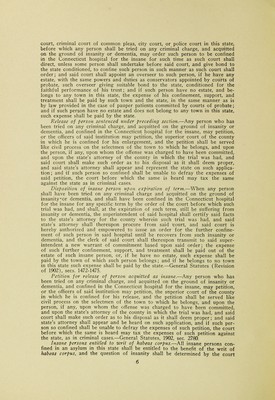
![provided for by law for the confinement of insane criminals in a state hospital for the insane.—Acts of 1909, chap. 87, sec. 16^. [Habeas corpus]—Who may have writ.—Every person restrained of his liberty under any pretense whatever, may prosecute a writ of habeas corpus, to inquire into the cause of the restraint, and shall be delivered therefrom when illegal.—Burns' Revised Statutes, 1901, sec. 1120. Habeas corpus.—Any person committed as insane may apply to the proper authorities for a writ of habeas corpus, and the question of insanity shall be decided at the hearing. An adverse decision shall not operate as a bar to the issuance of another writ: Provided, however, That writs of habeas corpus shall not issue oftener than once in every period of three months in such cases.— Burns' Revised Statutes, 1901, sec. 3239. IOWA Proceedings suspended.—If a defendant appears in any stage of the trial of a criminal prosecution, and a reasonable doubt arises as to his sanity, further proceedings must be suspended and a trial had upon that question. Trial.—Such trial shall be conducted in all respects, so far as may be, as the prosecution itself would be, except the defendant shall hold the burden of proof, and first offer his evidence and have the opening and closing argument. Discharge or commitment.—If the accused shall be found insane, no fur- ther proceedings shall be taken under the indictment until his reason is restored, and, if his discharge will endanger the public peace or safety, the court must order him committed to the department for the criminal insane at Anamosa until he becomes sane; but if found sane, the trial upon the indictment shall proceed, and the question of the then insanity of the accused cannot be raised therein. Return to custody.—If the accused is committed to the department for the criminal insane, as soon as he becomes mentally restored, the person in charge shall at once give notice to the sheriff and county attorney of the proper county of such fact, and the sheriff, without delay, must receive and hold him in cus- tody until he is brought to trial or judgment, as the case may be, or is legally discharged, the expense for conveying and returning him or any other, to be paid in the first instance by the county from which he is sent, but such county may recover the same from his estate, or a relative, or another county or municipal body bound to provide for or maintain him elsewhere, and the sheriff shall be allowed for his services the same fees as are allowed for conveying convicts to the penitentiary.—Code of 1897, sees. 5540-5543. Acquittal on ground of insanity.—If the defense is insanity of the defend- ant, the jury must be instructed, if it acquits him on that ground, to state that fact in its verdict. The court may thereupon, if the defendant is in custody, and his discharge is found to be dangerous to the public peace and safety, order him committed to the insane hospital, or retained in custody, until he becomes sane.—Code of 1897, sec. 5414. Discharge from hospital.—On the application of the relations or immediate friends of any patient in the hospital who is not .cured, and who cannot be safely allowed to go at liberty, the commissioners of the county where such patient belongs, on making provisions for the care of such patient within the county as in other cases, may authorize his discharge therefrom; but no patient who may be under criminal charge or conviction shall be discharged without the order of the district court or judge, and notice to the county attorney of the proper county.—Code of 1897, sec. 2276. Habeas corpus.—All persons confined as insane shall be entitled to the benefit of the writ of habeas corpus, and the question of insanity shall be decided at the hearing. If the judge shall decide that the person is insane, such decision shall be no bar to the issuing of the writ a second time, whenever it shall be alleged that such person has been restored to reason.—Code of 1897, sec. 2360. KANSAS [Insanity at time of trial].—Whenever any person under indictment or infor-](https://iiif.wellcomecollection.org/image/b2101209x_0012.jp2/full/800%2C/0/default.jpg)