A collection of state statutes relating to insanity in criminal cases / third report of Committee B of the American Institute of Criminal Law and Criminology.
- American Institute of Criminal Law and Criminology. Committee on Insanity and Criminal Responsibility.
- Date:
- 1913
Licence: Public Domain Mark
Credit: A collection of state statutes relating to insanity in criminal cases / third report of Committee B of the American Institute of Criminal Law and Criminology. Source: Wellcome Collection.
Provider: This material has been provided by the Harvey Cushing/John Hay Whitney Medical Library at Yale University, through the Medical Heritage Library. The original may be consulted at the Harvey Cushing/John Hay Whitney Medical Library at Yale University.
14/40 page 12
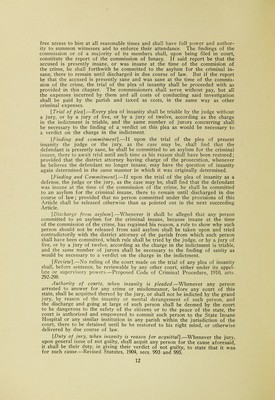
![free access to him at all reasonable times and shall have full power and author- ity to summon witnesses and to enforce their attendance. The findings of the commission or of a majority of its members shall, upon being filed in court, constitute the report of the commission of lunacy. If said report be that the accused is presently insane, or was insane at the time of the commision of the crime, he shall forthwith be committed to the asylum for the criminal in- sane, there to remain until discharged in due course of law. But if the report be that the accused is presently sane and was sane at the time of the commis- sion of the crime, the trial of the plea of insanity shall be proceeded with as provided in this chapter. The commissioners shall serve without pay, but all the expenses incurred by them and all costs of conducting said investigation shall be paid by the parish and taxed as costs, in the same way as other criminal expenses. [Trial of plea].—Every plea of insanity shall be triable by the judge without a jury, or by a jury of five, or by a jury of twelve, according as the charge in the indictment is triable, and the same number of jurors concurring shall be necessary to the finding of a verdict on this plea as would be necessary to a verdict on the charge in the indictment. [Finding and commitment].—If upon the trial of the plea of present insanity the judge or the jury, as the case may be, shall find that the defendant is presently sane, he shall be committed to an asylum for the criminal insane, there to await trial until such time as his reason shall have been restored; provided that the district attorney having charge of the prosecution, whenever he believes the defendant no longer insane, may have the question of insanity again determined in the same manner in which it was originally determined. [Finding and Commitment].—If upon the trial of the plea of insanity as a defense, the judge or the jury, as the case may be, shall find that the defendant was insane at the time of the commission of the crime, he shall be committed to an asylum for the criminal insane, there to remain until discharged in due course of law; provided that no person committed under the provisions of this Article shall be released otherwise than as pointed out in the next succeeding Article. [Discharge from asylum].—Whenever it shall be alleged that any person committed to an asylum for the criminal insane, because insane at the time of the commission of the crime, has regained his reason, a rule to show why such person should not be released from said asylum shall be taken upon and tried contradictorily with the district attorney of the parish from which such person shall have been committed, which rule shall be tried by the judge, or by a jury of five, or by a jury of twelve, according as the charge in the indictment is triable, and the same number of jurors shall be necessary to the finding of sanity as would be necessary to a verdict on the charge in the indictment. [Review].—No ruling of the court made on the trial of any plea of insanity shall, before sentence, be reviewable by any other court, either under its appel- late or supervisory powers.—Proposed Code of Criminal Procedure, 1910, arts. 292-298. Authority of courts, when insanity is pleaded.—Whenever any person arrested to answer for any crime or misdemeanor, before any court of this state, shall be acquitted thereof by the jury, or shall not be indicted by the grand jury, by reason of the insanity or mental derangement of such person, and the discharge and going at large of such person shall be deemed by the court to be dangerous to the safety of the citizens or to the peace of the state, the court is authorized and empowered to commit such person to the State Insane Hospital or any similar institution in any parish within the jurisdiction of the court, there to be detained until he be restored to his right mind, or otherwise delivered by due course of law. [Duty of jury, when insanity is reason for acquittal].—Whenever the jury, upon general issue of not guilty, shall acquit any person for the cause aforesaid, it shall be their duty, in giving their verdict of not guilty, to state that it was for such cause.—Revised Statutes, 1904, sees. 993 and 995.](https://iiif.wellcomecollection.org/image/b2101209x_0014.jp2/full/800%2C/0/default.jpg)