A collection of state statutes relating to insanity in criminal cases / third report of Committee B of the American Institute of Criminal Law and Criminology.
- American Institute of Criminal Law and Criminology. Committee on Insanity and Criminal Responsibility.
- Date:
- 1913
Licence: Public Domain Mark
Credit: A collection of state statutes relating to insanity in criminal cases / third report of Committee B of the American Institute of Criminal Law and Criminology. Source: Wellcome Collection.
Provider: This material has been provided by the Harvey Cushing/John Hay Whitney Medical Library at Yale University, through the Medical Heritage Library. The original may be consulted at the Harvey Cushing/John Hay Whitney Medical Library at Yale University.
33/40 page 31
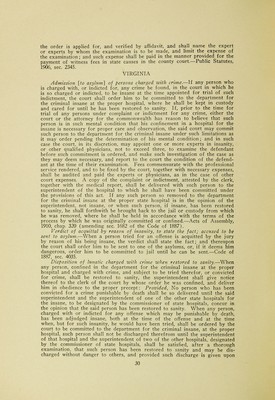
![the consent and advice of the commissioner of state hospitals and the special board of directors.—Acts of Assembly, 1910, chap. 321 (amending sec. 1687 of the Code of 1887). [Determination of sanity upon writ of habeas corpus].—Any person held in custody as insane may by means of a writ of habeas corpus have the ques- tion of the legality of his detention and of his sanity determined by a court of competent jurisdiction. If such person be not held in custody, then he may file his petition in the circuit court of the county or city in which he resides, or in which he was adjudged insane, or before the judge thereof in vacation, and upon such petition, after notice to the authorities of the hospital or to the per- son claiming the right to the custody of such adjudged insane person, such court or judge thereof in vacation shall determine whether such person be sane or insane.—Acts of Assembly, extra session, 1902-3-4, chap. 139, page 128 (amending sec. 1675 of the Code of 1887). WASHINGTON Exemptions from being committed as insane.—No case of idiocy, imbecility, harmless chronic mental unsoundness, or acute mania a potu shall be committed to the hospital for the insane.—Ballinger's Annotated Statutes, 1897, sec. 2666. Commitment of arraigned person.—The superior courts of the state shall have power to commit to the hospital for the insane any person who, having been arraigned for an indictable offense, shall be found by the jury to be insane at the time of such arraignment, and the costs of such commitment shall be paid in the same manner.—Ballinger's Annotated Statutes, 1897, sec. 2664. Criminal insane defined.—Any person who shall have committed a crime while insane, or in a condition of mental irresponsibility, and in whom such insanity or mental irresponsibility continues to exist, shall be deemed criminally insane within the meaning of this act. No condition of mind induced by the voluntary act of a person charged wth a crime shall be deemed mental irrespon- sibility within the meaning of this act. Plea of insanity.—When it is desired to interpose the defense of insanity or mental irresponsibility on behalf of one charged with a crime, the defendant, his counsel or other person authorized by law to appear and act for him, shall at the time of pleading to the information or indictment file a plea in writing in addition to the plea or pleas required or permitted by other laws than this, setting up (1) his insanity or mental irresponsibility at the time of the com- mission of the crime charged, and (2) whether the insanity or mental irrespon- sibility still exists, or (3) whether the defendant has become sane or mentally responsible between the time of the commission of the crime and the time of the trial. The plea may be interposed at any time thereafter, before the sub- mission of the cause to the jury if it be proven that the insanity or mental irresponsibility of the defendant at the time of the crime was not before known to any person authorized to interpose a plea. Verdict.—If the plea of insanity or mental irresponsibility be interposed, and evidence upon that issue be given, the court shall instruct the jury when giving the charge, that in case a verdict of acquittal of the crime charged be returned, they shall also return special verdicts finding (1) whether the defend- ant committed the crime and if so, (2) whether they acquit him because of his insanity or mental irresponsibility at the time of its commission, (3) whether the insanity or mental irresponsibility continues and exists at the time of the trial, and (4) whether, if such condition of insanity or mental irresponsibility does not exist at the time of the trial, there is such likelihood of a relapse or recurrence of the insane or mental irresponsible condition, that the defendant is not a safe person to be at large. Forms for the return of the special ver- dicts shall be submitted to the jury with the forms for the general verdicts. Discharge.—If the jury find by their special verdicts that the defendant committed the crime charged, that he is acquitted because of his insanity or mental irresponsibility at the time of its commission, and that before the trial he has become a sane or mentally responsible person, and is not liable to a relapse or recurrence of the insane or mentally irresponsible condition, and is a safe person to be at large, he shall be discharged. If the jury find that the](https://iiif.wellcomecollection.org/image/b2101209x_0033.jp2/full/800%2C/0/default.jpg)