Volume 1
The impact of spending cuts on science and scientific research : sixth report of session 2009-10.
- Great Britain. Parliament. House of Commons. Select Committee on Science and Technology
- Date:
- 2010
Licence: Open Government Licence
Credit: The impact of spending cuts on science and scientific research : sixth report of session 2009-10. Source: Wellcome Collection.
15/48 (page 11)
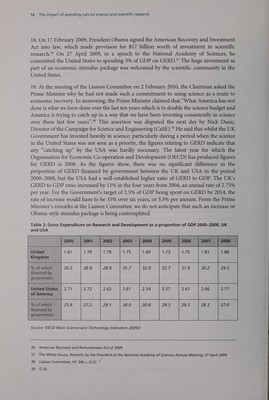
![box—£1.3 billion a year—would be better spent protecting the spending in this area. This would go a long way to shoring up the science budget, which for 2010-11 is £3.2 billion.” 15. That same day, Professor Alan Thorpe, Chair of Research Councils UK (RCUK), told us that at present the Research Councils were basing their forward planning “on the basis of flat cash” allocations.’ This was further to the evidence we took from him on 2 December 2009, when he told us that the Research Councils were making plans on flat cash and “other scenarios”.** According to Professor Thorpe, the consequences of flat cash allocations or a reduction would be: [...] extremely serious [...] it is an investment, the research budget, so it has a huge gearing in terms of the economy. If we reduce funding, it is not just a matter of reining back a few research grants; it has a huge knock-on impact right through the economy in terms of the number of highly skilled people we are training in universities. University income levels will go down so universities will find they are less sustainable. Our ability to be world-leading in terms of the excellence of the research will be threatened and, of course, we get a lot of inward investment in the UK because we are seen as having that excellent base of researchers. In terms of facilities [...] negotiations depend on the UK having a significantly strong base. If that is reduced [...] the ability to partner countries that are actually undergoing some stimulus packages in terms of science will be very difficult.” The Government's ambition and international comparators 16. The Government has taken significant steps to increase investment in science in real terms over the past six years, and it is against a background of rising investment and an increased science budget that this inquiry takes place. The Government’s strategy for science in the UK was set out in the Science and Innovation Investment Framework 2004- 2014. In that document, it was stated that: The Government’s long-term objective for the UK economy is to increase the level of knowledge intensity in the UK (as measured by the ratio of R&D across the economy to national gross domestic product), from its current level of around 1.9% to 2.5% by around 2014. If achieved, this would put the UK in a position to secure a leading place among the major European countries, and substantially close the gap between the UK and the USA, the best performing innovation-driven major economy.” 17. The relevant econometric measure is known as gross expenditure on research and development (GERD), expressed as a proportion of gross domestic product (GDP). As the passage above notes, GERD over GDP indicates the “level of knowledge intensity”, and is a measure better suited to international comparisons than any comparison of direct funding. 31 As above, section 10.3 S2eON21 33 Science and Technology Committee, The work of the UK research councils, 2 December 2009, HC 102, Q 14 34 As above, Q 15 35. HMTreasury, Science and Innovation Investment Framework, July 2004, para 1.4](https://iiif.wellcomecollection.org/image/b32220534_0001_0015.jp2/full/800%2C/0/default.jpg)