Volume 1
The impact of spending cuts on science and scientific research : sixth report of session 2009-10.
- Great Britain. Parliament. House of Commons. Select Committee on Science and Technology
- Date:
- 2010
Licence: Open Government Licence
Credit: The impact of spending cuts on science and scientific research : sixth report of session 2009-10. Source: Wellcome Collection.
18/48 (page 14)
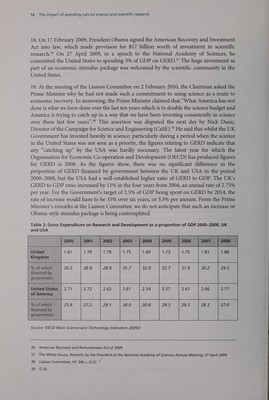
![3 Demonstrating impact 23. When he gave evidence to us on 3 February, Professor Brian Cox drew attention to the 1996 review commissioned by the Treasury of The relationship between publicly funded basic research and economic performance by the Science Policy Research Unit at the University of Sussex.“ On the issue of assessing the economic benefits arising from investment in science, the review concluded that: | Virtually all [studies of the impact of research on productivity] have found a positive rate of return, and in most cases the figure has been comparatively high. However, these attempts have been beset with both measurement difficulties and conceptual problems such as the assumption of a simple production function model of the science system. [<i One can attempt to estimate the rate of return to basic research but only on the basis of very questionable assumptions. [Edwin] Mansfield’s work suggests that there is a very substantial rate of return, but the precise figure he arrives at (28%) is open to some doubt.* 24. That review also suggested that “Government expectations about the benefits from basic research are changing. A new ‘social contract’ is emerging in which there are more specific expectations that basic research should generate economic and social benefits in return for the substantial public funds that it receives”.“* Lord Drayson confirmed that the idea of a social contract did influence Government policy in this area, when he told us that “this is taxpayers’ money [...] researchers should expect to be part of a process which ensures that that taxpayers’ money has the biggest impact that it possibly can have for the benefit of the country, whether that is economic, or social, or what have you”.® 25. The so-called “impact agenda”, as referred to in several of the memoranda we received,** has long been the policy of the Research Councils. Professor Thorpe reminded us that it was “not for nothing that our [Research Councils UK’s] strap line is excellence with impact, because that has actually characterised the last 20 years up to now’.”” In its memorandum, Universities UK referred to “accusations that include the emergence of an ‘instrumentalist’ approach to funding research and that there is too great a focus on research as an economic driver”.** It was nevertheless persuaded that: 42 Martin, Salter et. a/.,.The relationship between publicly funded basic research and economic performance: A SPRU Review, July 1996; Q 6, Q 31 43 Martin, Salter et. a/., para 8.1.1 44 As above, para 8.2 45 Q269 46 Ev 72 [University and College Union], para 1; Ev 169 [University of Leeds], para 3; Ev 28 [million+], section 6; Ev 69 [Universities UK], para 19 47 Q71 f 48 Ev 68, para 14](https://iiif.wellcomecollection.org/image/b32220534_0001_0018.jp2/full/800%2C/0/default.jpg)