Volume 1
The impact of spending cuts on science and scientific research : sixth report of session 2009-10.
- Great Britain. Parliament. House of Commons. Select Committee on Science and Technology
- Date:
- 2010
Licence: Open Government Licence
Credit: The impact of spending cuts on science and scientific research : sixth report of session 2009-10. Source: Wellcome Collection.
19/48 page 15
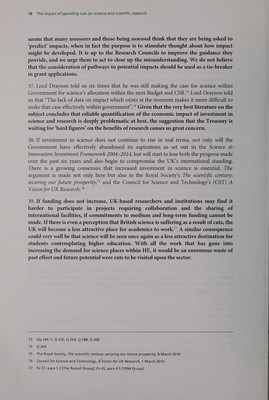
![moves by the Research Councils and HEFCE have, however, sought to foster a system which incentivises impact at every opportunity rather than seeking to redirect research funding into particular areas that have an immediate or apparent impact, economic or otherwise. In this regard the debate has, to an extent, unfortunately become distorted and artificially polarised.” 26. The question of impact arose in two separate contexts in the course of our inquiry. The first was in HEFCE’s proposals for a replacement for the Research Assessment Exercise (RAE), the process by which the excellence of research in universities is assessed. Proposals for the new assessment, the Research Excellence Framework (REF) include a retrospective measure of impact weighted at 25% of the overall assessment. The second context in which impact arose was the Research Councils’ grant application forms. The forms invite researchers to “add to their case for support by describing the potential impact of their work, and pathways towards realising that, under the following headings [academic beneficiaries, impact summary, impact plans]”.°° The Research Excellence Framework 27. Funding of research activities within the higher education sector takes place under a system of “dual support”. HEFCE provides grants to support infrastructure and running costs, while the Research Councils, the EU, charities and Government fund specific projects. HEFCE allocates grants on the basis of quality-related research funding (QR). The quality of research was until recently assessed through the RAE, an exercise which was held roughly quadrennially between 1986 and 2008. The REF will place greater emphasis upon the “impact” of research to the economy, society, public policy, culture and quality of life. The proposals attracted significant comment in the memoranda we received. 28. Opinion was split on the merits of the inclusion of impact. The majority of organisations representing the universities broadly welcomed the proposals, albeit with some caveats.’ The concern expressed over the inclusion of impact in the REF fell into three camps: those who thought 25% was too great a weighting to place on an untested measure;”* those who disputed the feasibility of assessing impact at all;°’ and those who postulated a ‘hierarchy of impacts’, with economic benefits being prioritised over all others.** In its memorandum, HEFCE acknowledged that “concerns were raised by some academic associations and the University and College Union (UCU) about the potential adverse consequences of using impact as an element in assessment”, and set out the steps it was taking to address them.» It is conducting a pilot involving 29 Higher Education (HE) institutions and five expert panels, comprising leading academics and research user representatives from the private, public and third sectors”.°° The outcome of the pilot 49 Ev 68, para 15 50 Ev 15, para 8 51 Ev 32, para 2.9 [The Russell Group]; Ev 44, para 2.1 and Ev 45, para 2.4 [The 1994 Group]; Ev 28, section 6 [million+]; and Ev 40, para 9 [University Alliance]; Ev 67 [Universities UK] 52 Ev69, para 19 [Universities UK]; Ev 40, para 9 [University Alliance] 53 e.g. Ev 126, para 6 [Wellcome Trust] 54 Ev 72, para 8 [UCU], Ev 28, para 6 [million+] 55 Ev65, para5](https://iiif.wellcomecollection.org/image/b32220534_0001_0019.jp2/full/800%2C/0/default.jpg)




 No text description is available for this image
 No text description is available for this image
 No text description is available for this image