Volume 1
The impact of spending cuts on science and scientific research : sixth report of session 2009-10.
- Great Britain. Parliament. House of Commons. Select Committee on Science and Technology
- Date:
- 2010
Licence: Open Government Licence
Credit: The impact of spending cuts on science and scientific research : sixth report of session 2009-10. Source: Wellcome Collection.
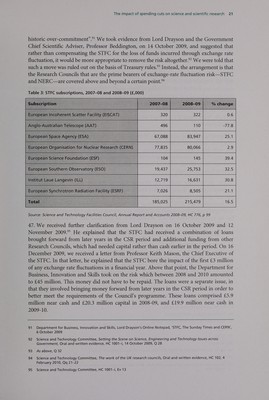
29/48 page 25
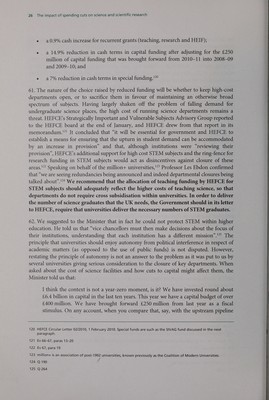
![the increase in A-level entries over the past 20 years, and also over the inequality of opportunity for students at non-selective schools to study separate sciences. 57. Sir Alan Langlands told us that “huge government expenditure” had been put into growing science, technology, engineering and mathematics subjects within higher education, in “a strategy designed to deal with market failure”, achieved through subsidising the subjects and inducing demand.'” He was explicit in his assertion that “we must not lose momentum [...] now we have higher numbers of young people study mathematics at GCSE and A levels than we have had for years”.!!* The Royal Society noted that the cumulative shortfall in meeting science and mathematics recruitment targets between 2000-01 and 2007-08. 58. The Government set out its strategy for increasing the uptake of STEM subjects at undergraduate level in Higher Ambitions, which was published on 3 November 2009.1! According to the Department’s memorandum, it will “provide space for growth in STEM student numbers as demand increases, in a tighter fiscal climate over the next decade”, “{ask] HEFCE to maintain a funding system which does not create disincentives for universities to offer STEM provision” and improve “the dialogue between businesses and universities about labour market needs”.'!° 59. Effort also needs putting into supporting young scientists beyond their undergraduate years. In the Royal Society’s report on The scientific century: securing our future prosperity, this point is made very strongly, where it is noted that “the majority of people undertaking a PhD will end up in careers outside scientific research”, and that only 0.45% of those gaining PhDs become Professors.'’” Whilst it would be unrealistic to expect every PhD student to become a Professor, we are concerned that academia is losing some of its brightest and best to alternative careers. The life of a young research scientist needs making more attractive when compared to the bright lights of industry and commerce. Funding science within higher education 60. It is generally accepted that the costs associated with the operation of facilities necessary for the teaching of science subjects are higher than those for arts subjects..''’ Nevertheless, the Minister told us that HEFCE had sought to minimise the impact of cuts on science, research and teaching, with cuts falling more on capital than on anything else.” Indeed, HEFCE’s announcement of the size of the ‘pots’ for HE funding in 2010-11 on 1 February 2010 was as follows: 11 ay Ev 30, para 7.6 112 Q223 113 As above 114 The Royal Society, The scientific century: securing our future prosperity, p 65 115 Department for Business, Innovation and Skills, Higher Ambitions, 3 November 2009 116 As above, paras 75-77 117 The Royal Society, The scientific century: securing our future prosperity, 8 March 2010, p 14 118 Q 252 [Rt Hon David Lammy MP]](https://iiif.wellcomecollection.org/image/b32220534_0001_0029.jp2/full/800%2C/0/default.jpg)