The modern practice of physic : exhibiting the character, causes, symptoms, prognostics, morbid appearances, and improved method of treating the diseases of all climates / by Robert Thomas.
- Robert Thomas
- Date:
- 1822
Licence: Public Domain Mark
Credit: The modern practice of physic : exhibiting the character, causes, symptoms, prognostics, morbid appearances, and improved method of treating the diseases of all climates / by Robert Thomas. Source: Wellcome Collection.
Provider: This material has been provided by the National Library of Medicine (U.S.), through the Medical Heritage Library. The original may be consulted at the National Library of Medicine (U.S.)
66/1074
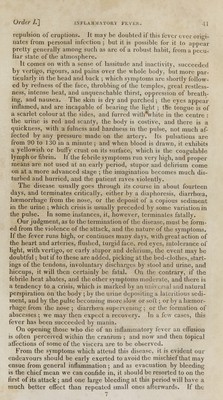
![Dr. Haygarth* has employed much attention for many years to ascertain, by numerous facts which had occurred to himself and to other practitioners with whom he had professional intercourse, in what manner the contagion of typhus is propagated, in order to discover how it may be prevented. The conclusions which he has deduced from these facts are of very great importance, for the prevention of misery and preservation of life. They may be briefly comprised, he thinks, in the following natural laws of typhous contagion. I. Miasms (or contagious vapours,) issuing from patients ill of typhus, or from the poison contained in their dirty clothes, utensils, &c. are diffused or dissolved in air, and thus infect persons who are exposed to them. II. These miasms render the air infectious but to a little distance from the patient, or the poison. They never extend so far as to infect persons in an adjoining street, nor an adjoining house, nor in an adjoining room of the same house, nor even in the patient's own chamber, if large, airy, and kept clean.! III. Not more than one person in twenty-three is naturally ex- empted from typhus; for when one hundred and eighty-eight men, women, and children, were exposed fully to the typhous contagion, for days and nights together, in small, close, and dirty rooms, all of them except eight were infected with this fever.J IV. The miasms of variolous, scarlet, typhous, and other conta- gions, do not render clothes, &c. exposed to them contagious.§ V. Hence, it follows, that the only way by which typhus can be conveyed from the patient's room, so as to infect others out of it, is in the form of contagious dirt, as dirty clothes, utensils, &c. and consequently that the contagkm may be completely destroyed by washing them clean. VI. The typhous poison remains in the body in a latent state from about the tenth to the seventy-second day,|] reckoning between the time of exposure to the contagion and the commencement of the fever. This law of nature was discovered by Dr. Haygarth in j 781. from observations on seventy-two cases. It was fully confirmed by Dr. Bancrofts in 1809, from observations on ninety-nine cases, who as orderlies and nurses attended the army which had arrived at Ply- mouth from Corunna, infected with typhus: they had not been pre- viously exposed to contagion. He observed that the latent period of typhus varied from the thirteenth to the sixty-eighth day. From these laws of contagion observed by nature, Dr. Haygarth concludes that typhus may be easily and certainly prevented by ventilation (in large, airy, and clean rooms ;) or by separation (into * See his Letter to Dr Percival on the Prevention a>f Infectious Fevers. i See his Letter to Dr. Percival, p. 76. f See Letter, p. 31. § See Letter, p 54; and his Inquiry, pp. 67, 86; and his Sketch,' pp. 217, 369, 384,386, 404, 542; and the cases related under Scarlet Fever, where 65 youn^ la- dies were not infected, though approached by clothes exposed to contagious miasms. |j See Letter, pp. 64, 69. If See his Essay on Yellow and Typhus Fevers, p. 615.](https://iiif.wellcomecollection.org/image/b21159117_0066.jp2/full/800%2C/0/default.jpg)


 No text description is available for this image
 No text description is available for this image
 No text description is available for this image