Volume 4
Studies in neurology / by Henry Head ; in conjunction with W.H.R. Rivers [and others].
- Henry Head
- Date:
- 1920
Licence: Public Domain Mark
Credit: Studies in neurology / by Henry Head ; in conjunction with W.H.R. Rivers [and others]. Source: Wellcome Collection.
66/552 (page 382)
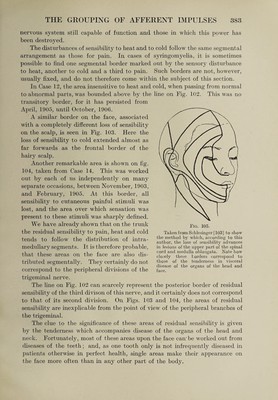
![thermal stimuli. An intramedullary lesion may manifest itself locally by an area of cutaneous analgesia and thermo-anaesthesia whose borders correspond almost exactly to those at which sensation to pain, heat and cold ceases. But much of this area may be sensitive to deep painful stimuli, such as excessive pressure. Moreover, tactile sensibility is usually disturbed over a considerably smaller extent, and the borders of this loss of sensation do not correspond to those of the cutaneous analgesia. It is therefore of fundamental importance, in every case, to test each form of sensation separately, and to record the border at which it ceases and the border at which it begins, when the stimulus travels from sensitive to insensitive areas. If these two borders correspond closely, and if the same borders are obtained on several different occasions, it is possible to say that this area may be a segmental border. The* form and extent of the boundary of the residual Fig. 102. Fig. 103. Fig. 104. Fig. 102.—From Case 12 (p. 444). To show the extent of the residual sensibility to painful and thermal stimulation in 1906. Fig. 103.—From Case 16 (p. 458.) To show the extent of the residual sensibility to painful cutaneous stimuli. Fig. 104.—From Case 14 (p. 450). To show the extent of the residual sensibility to painful cutaneous stimuli, taken from a series of observations made between November, 1903, and February, 1905. sensibility only will determine if the disturbance of sensation is the expression of intramedullary segmentation. We have brought sufficient evidence to prove the truth of Max Laehr’s [64] original statement, that the phenomena of loss of sensation, caused by intra¬ medullary disease,pointed to a segmental arrangement of the afferent mechanism at the level of the lesion. But it will be well in the light of this knowledge to examine some of those remarkable borders on the face between parts of normal and abnormal sensibility, so commonly found in cases of syringomyelia. We shall bring forward such cases only, where these borders remained unaltered for considerable periods. For, when the extent of the loss of sen¬ sation is spreading, a single examination may yield results which are transitory, due to the want of adjustment of the higher sensory mechanism to shifting structural changes. But, when a sensory border has remained constant over a long period, as occurs not infrequently in cases of syringomyelia, we can assume that it represents the division between those parts of the central](https://iiif.wellcomecollection.org/image/b31362527_0004_0066.jp2/full/800%2C/0/default.jpg)