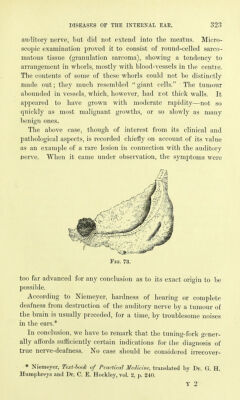
A manual of diseases of the ear / by George P. Field.
- Field, George P (George Purdey)
- Date:
- 1893
Licence: Public Domain Mark
Credit: A manual of diseases of the ear / by George P. Field. Source: Wellcome Collection.
Provider: This material has been provided by The University of Leeds Library. The original may be consulted at The University of Leeds Library.
384/486 (page 328)
![apparatus, by which its acoustic properties have been interfered with. For example, a little film of mucus spread over the inner side of the membrana tympani is sufficient to alter the periodicity of its atmospheric vibrations, or even partially to quench them. Thus deafness and tinnitus will co-exist here; but as soon as the removal or dispersion of the coating from the membrana tympani occurs, both symptoms will togetlier instantaneously vanish. We are amply warranted by facts like these in con- cluding that the membrana tympani is generally, in some way or another, concerned in causing tinnitus. Next, says Allen, to interference with the membrana tympani, closure of the Eustachian tube is the most common cause of singing in the ears. This also, on analysis, proves to be such, not directly, but in the following manner:—A closed tube necessitates a too great curvature inwards of the membrana tympani, and consequently an abnormal pressure upon the nervous expansion witliin the labyrinth. This is a most im- portant point to bear in mind. Hinton, also, in his supplement to Toynbee's work (p. 452), makes the following remarks :— When of a beating character and synchronous with the pulse, it [tinnitus] is obviously refer- able to vascular conditions as its exciting cause, and among others sometimes to aneurysm of the basilar artery.* In some cases, pressure over the course of the carotids immediately beneath the ear temporarily arrests it. In any such case, re- gard, of course, should be had to the condition of the heart. Some cases, when connected with headache, are said to be dependent on the weakened right side of the heart. Perhaps, however, the most frequent cause of tinnitus is pressure on the labyrinth, as illustrated by the sound heard on pressing on the membrana tympani with a probe. But, in estimating the causes of tinnitus, it appears to me that the great frequency with wliich enlargement and fulness of the blood-vessels of the labyrinth are found, on dissection, to accompany even slight in- * In the Transactions of the American Otolog. Soc, 1810, Dr. Spencer relates a case of supposed traumatic aneurysm of the middle meningeal artery, where the tinnitus was synchronous with the pulse, and could be plainly heai d by means of the diagnostic tube inserted into the meatus.](https://iiif.wellcomecollection.org/image/b21520379_0384.jp2/full/800%2C/0/default.jpg)