A dictionary of British birds : reprinted from Montagu's Ornithological dictionary, and incorporating the additional species described by Selby; Yarrell, in all three editions, and in natural-history journals / compiled and edited by Edward Newman.
- George Montagu
- Date:
- 1866
Licence: Public Domain Mark
Credit: A dictionary of British birds : reprinted from Montagu's Ornithological dictionary, and incorporating the additional species described by Selby; Yarrell, in all three editions, and in natural-history journals / compiled and edited by Edward Newman. Source: Wellcome Collection.
29/440 page 25
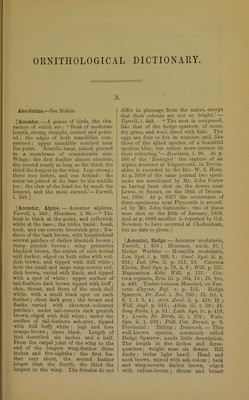
![ORNITHOLOGICAL DICTIONARY A. Aberdevine.—See Sisldn. [Accentor. — A genus of birds, the cha- racters of which are : “ Beak of moderate length, strong, straight, conical and point- ed ; the edges of both mandibles com- pressed ; uppor mandible notched near the point. Nostrils basal, naked, pierced in a membrane of considerable size. Wings: the first feather almost obsolete, the second nearly as long as the thii-d, the third the longest in the wing. Legs strong; three toes before, and one behind; the outer toe joined at its base to tbe middle toe ; the claw of the hind toe by much the longest, and the most cui-ved.”—YaiTcZi, L 249.] [Accentor, Alpine. — Accentor alpinus, Yarrell, i. 249 ; Hewitson, i. 96.— “ The beak is black at the point, and yellowish white at the base ; the irides hazel: head, neck, and ear-coverts brownish grey; fea- thers of the back brown, with longitudinal central patches of darker blackish brown ; rump greyish browm; wing primaries blackish brown, the centre of each tertial still darker, edged on both sides with red- dish brown, and tipped with dull white; both the small and large wing-coverts red- dish browTQ, vailed with black, and tipped with a spot of white; upper surface of tail-feathers dark bi’own tipped with buff; chin, throat, and front of the neck dull white, with a small black spot on each feather; chest dark grey; the breast and flanks varied with chestnut - coloured patches: under tail-coverts dark gi-eyish brown, edged with dull white; under the surface of tail-feathers ash-grey, tipped with duU huffy white : legs and toes orange-brown; claws black. Length of bird described six inches and a half. From the carpal joint of the wing to the end of the longest wing-feather three inches and five-eighths; the first fea- ther very short, the second feather longer than the fourth, the third the longest in the wing. The females do not differ in plumage from the males, except that theii’ colours are not so bright.” — Yarrell, i. 249. “ The nest is composed, like that of the hedge sparrow, of moss, dry grass, and wool, lined with haii’. The eggs are four or five in number, and, like those of the allied species, of a beautiful spotless blue, but rather more intense in their colouring.”—Heioitson, i. 96. At p. 566 of the ‘ Zoologist ’ the capture of an Alpine Accentor at Teignmouth, in Devon- shire, is recorded by the Rev. W. S. Hore. At p. 5958 of the same journal two sped-, mens are mentioned by Mr. John Porter as having been shot on the dowms near Lewes, in Sussex, on the 26th of Decem- ber, 1858. At p. 6377 the occurrence of three specimens near Plymouth is record- ed by Mr. John Gatcombe : two of these were shot on the 10th of Januaiy, 1859. And at p. 6889 another is reported by Col. Newman to have occurred at Cheltenham, but no date is given.] [Accentor, Hedge. — Accentor moduloiis, Yarrell, i. 253 ; Heioitson, xxvii. 97. ] Hedge Warbler. — Motacilla modularis, Lin. Syst. i. p. 329, 3; Gmel. Syst. ii. p. 952; Ind. Orn. ii. p. 511, 13. Curruca EUotce, Raii Syn. p. 79, A. 6 ; Will. p. 157. Magnanima Aldr, Will. p. 157. Cor- iTica sepiaiia, Bris. iii. p. 394, 12; Ib. 8vo, p. 420. Traine-buisson Mouchet, ou Fau- vette d’hyver, Buf. v. p. 151. Hedge Sparrow, Br. Zool. i. No. 150; Ib. fol. t. S. 1, f. 3, 4; Arct. Zool. ii. p. 418, H. ; Will. Angl. p. 215; Albin, iii. t. 59; Ib. Song Birds, t. p. 81; Lath. Syn. iv. p. 419, 9 ; Lewin, Br. Birds, iii. t. 102 ; Wale. Syn. ii. t. 232; Pult. Cat. Dorset, p. 9. Provincial : Titling ; Dunnock. — This well-known species, commonly called Hedge Sparrow, needs little description. The length is five inches and three- quai-ters; weight near six drams. Bill dusky; irides light hazel. Head and neck brown, mixed with ash-colour ; back and wing-coverts daidcer brown, edged with rufous-brown; throat and breast](https://iiif.wellcomecollection.org/image/b28089935_0029.jp2/full/800%2C/0/default.jpg)




 No text description is available for this image
 No text description is available for this image
 No text description is available for this image