A dictionary of British birds : reprinted from Montagu's Ornithological dictionary, and incorporating the additional species described by Selby; Yarrell, in all three editions, and in natural-history journals / compiled and edited by Edward Newman.
- George Montagu
- Date:
- 1866
Licence: Public Domain Mark
Credit: A dictionary of British birds : reprinted from Montagu's Ornithological dictionary, and incorporating the additional species described by Selby; Yarrell, in all three editions, and in natural-history journals / compiled and edited by Edward Newman. Source: Wellcome Collection.
408/440 page 380
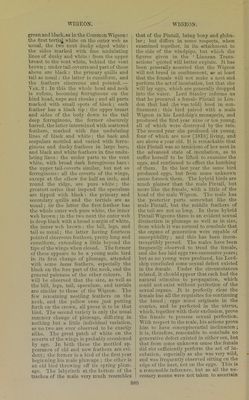
![green and black, as in the Common Wigeon: the first tertiaj white on the outer web as usual, the two next dusky edged white: the sides marked with fine undulating lines of dusky and white : from the upper breast to the vent white, behind the vent brown; under tail-coverts and part of those above are black : the pirimary quills and tail as usual: the latter is cuneiform, and the feathers cinereous and pointed. — Vau. 2 : In this the whole head and neck is rufous, hecoming ferruginous on the hind head, nape and cheeks ; and all parts marked with small spots of black; each feather has a black tip : the upper breast and sides of the body down to the tail deep ferruginous, the former obscurely barred, the latter intermixed with scattered feathers, marked Avith fine undulating lines of black and white: the back and scapulars mottled and varied with ferru- ginous and dusky feathers in large bars, and black and Avhite feathers in fine undu- lating lines: the under parts to the vent white, with broad dark ferruginous bars : the upper tail-coverts similar, but not so ferruginous: all the coverts of the wings, except at the elbow for half an inch, and round the ridge, are pure Avhite; the greatest series that impend the speculum are tiitped Avilh black: the primaiy and secondary quills and the tertials are as usual; in* the latter the first feather has the whole outer web pure white, the inner web brown ; in the tAvo next the outer Aveb is deep black Avith a broad margin of white, the inner web broAvn : the bill, legs, and tail as usual; the latter having fourteen pointed cinereous feathers, pretty long and cuneiform, extending a little beyond the tips of the Avings Avhen closed. The fonner of these appears to be a young male bird in its first change of plumage, attended with some histis feathers, especially the black on the fore part of the neck, and the general paleness of the other colours. It will be observed that the size, as Avell as the bill, legs, tail, speculum, and tertials are similar to those of the IVigeon. The feAv remaining nestling feathers on the neck, and the yelloAv ones just putting forth on the croAUt, all prove it to be that bird. The second variety is only the usual summer change of ydumage, difiering in nothing but a little individual variation, as no two are ever observed to be exactly alike. The great patch of Avhite on the coverts of the wings is probably occasioned by age. In both these the mottled ap- pearance of old and new feathers are evi- dent ; the former is a bird of the first year beginning his male plumage ; the other is an old bird throAring ofl’ its spring plum- age. The laliArinth at the bottom of the trachea of the m.alo very much resembles that of the Pintail, being bony and globu- lar ; but differs in some respects, Avben examined together, in its attachment to the side of the Avindpipe, but Avhieh the figures given in the ‘ Linnean Trans- actions ’ quoted Avill better explain. It has been generally asserted that the Wigeon AA'ill not breed in confinement, ar at least tliat the female will not make a nest and perform the act of incubation, but that she Avill lay eggs, which are geirerally dropped into the Avater. Lord Stanley informs us that he pi-ocured a female Pintail in Lon- don that had (he Avas told) bred in con- finement : this bird paired Avith a male Wigeon in his Lordship’s menagerie, and produced the first year nine or ten young, all of Avhich AA'ere destroyed by the rats. The second year she produced six young, four of w’hich are uoav [IBIti] living, and are above a year old. It is remarkable that this Pintail Avas so tenacious of her nest in the advanced state of incubation, as to suffer herself to be lifted to examine the eggs, and continued to effect the hatching of them. In the last year the same bird produced eggs, but from some unknoA\n I cause forsook them. The hj-brid birds are I much plainer than the male Pintail, but more like the female, with a little of the head of the male Wigeon. The male has the posterior parts someAvhat like the male Pintail, but the middle feathers of the tail are not so long. In these hybrid Pintail Wigeons there is an evident sexual distinction in plumage ns Avell as in size, from which it was natural to conclude that tlie organs of generation Avere capable of susceptibility ; and this has been incon- trovertibly jiroved. The males have been frequently observed to ti'end the female, and she has laid eggs tvA’o successive years; but as no young AA’ere produced, his Lord- ship concluded some sexual defect existed in the female. Under the circumstances related, it should appear that each had the natural stimulus to propagation, AA'hich could not exist without jierfection of the sexual organs. Jt is perfectly clear the female has all the requisites for continuing the breed; eggs must originate in the ovaries, and be peifected in the uterus, which, together Avith their exclusion, prove the female to possess sexual perfection. With respect to the male, his actions proA-e him to have concupiscential inclination; it is, therefore, reasonable to conclude no generative defect existed in either sex, but that from some unknoAvn cause the female did not sufficiently perform the act of in- cubation, especially as she was veiy wild, and Avas frequently observed sitting on the edge of the nest, not on the eggs. This is a reasonable inference, but as all the ne- cessary means were not talten to ascertain](https://iiif.wellcomecollection.org/image/b28089935_0408.jp2/full/800%2C/0/default.jpg)