A dictionary of British birds : reprinted from Montagu's Ornithological dictionary, and incorporating the additional species described by Selby; Yarrell, in all three editions, and in natural-history journals / compiled and edited by Edward Newman.
- George Montagu
- Date:
- 1866
Licence: Public Domain Mark
Credit: A dictionary of British birds : reprinted from Montagu's Ornithological dictionary, and incorporating the additional species described by Selby; Yarrell, in all three editions, and in natural-history journals / compiled and edited by Edward Newman. Source: Wellcome Collection.
83/440 page 55
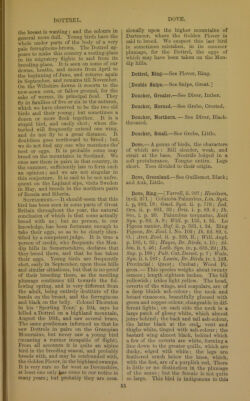
![the breast is wanting; and tlie colours in general nioi-e dull. Young birds have the whole under parts of the body of a very pale ferruginous-brown. The Dottrel ap- pears to make this country a resting-place in its migrator}' flights to and from its breeding-place. It is seen on some of our do^vns, heaths, and moors from April to the beginning of Jime, and returns again in September, and remains till November. On the Wiltshire downs it resorts to the new-sown com, or fallow ground, for the sake of worms, its principal food. They fly in families of five or sis in the autumn, which we have observed to be the two old birds and their young ; but sometimes a dozen or more flock together. It is a stupid bird, and easily shot; when dis- turbed will frequently extend one wing, and do not fly to a gi'eat distance. It doubtless goes northward to breed; but. we do not find any one who mentions the' nest or eggs. It is probable some may breed on &e mountains in Scotland. We once saw them in paii'S in that country, in the summer, sufificieutly late to form such an opinion; and we are not singular in this conjecture. It is said to be not unfre- quent on the Lapland alps, visits Sweden in May, and breeds in the northern parts of Russia and Siberia. Supplement.— It should seem that this bird has been seen in some parts of Great Britain throughout the yeai’, the natural conclusion of which is that some actuaUy breed -w-ith us; but no person, to our knowledge, has been fortunate enough to take their eggs, so as to be clearly iden- tified by a competent judge. It is trae a person of credit, who frequents the Men- dip hills in Somersetshii’e, declares that they breed there, and that he has taken their eggs. Young birds are frequently shot, early in September, upon those hills and similar situations, but that is no proof of their breeding there, as the nestling plumage continues till towards the fol- lowing spring, and is very different from the adult, being entirely destitute of the bands on the breast, and the ferruginous and black on the belly. Colonel Thornton in his ‘ Sporting Tour,’ p. 104, says he killed a Dottrel on a highland mountain, August the loth, and saw several brace. The same gentleman informed us that he saw Dottrels in pairs on the Grampian Mountains, but never saw a young bird (meaning a runner incapable of flight). From all accounts it is quite an alpine bird in the breeding season, and probably breeds with, and may be confounded with, the Golden Plover, in the highland swamps. It is very rare so far west as Devonshire, at least one only iwis come to our notice in many years; but probably they are occa- sionally upon the higher mountains of Dartmoor, whore the Golden Plover is said to breed. We suspect this last bird is sometimes mistaken, in its summer plumage, for the Dottrel, the eggs of which may have been taken on the Men- dip hills. Dottrel, Ring—See Plover, Ring, [Double Snipe.—See Snipe, Great.] Doucker, Greater.—See Diver, Imber. Doucker, Homed.—See Grebe, Crested. Doucker, Northern. — See Diver, Black- throated. Doucker, Small.—See Grebe, Little. Dove.— A genus of birds, the characters of which are : Bill slender, weak, and strait at ’the base. Nostrils lodged in a soft protuberance. Tongue entire. Legs short. Toes divided to their origin. Dove, Greenland.—See Guillemot, Black; and Auk, Little, Dove, Ring.—[ Yarrell, ii. 287; Hewitson, Ixvii. 271.] Columba PMumbus, Lin. Syst. i. Pj 282, 19; Gmel. Syst. ii. p. 770 ; Ind. Orii. ii. p. 601, 32; Bris. i. p. 89, 6; Ib. 8vo, i. p. 20. Palumbus torquatus, Baii Syn. p. 62, A. 9; Will. p. 135, t. 35. Le Pigeon ramier, BiLf. ii. p. 531, t. 24. Ring Pigeon, Br. Zool. i. No. 102; Ib. fol. 89, t. 0.; Aret. Zool. ii. p. 329, B.; Will. Angl. p. 185, t. 35 ; Hayes, Br. Birds, t. 15 ; Al- bin. ii. t. 46; Lath. Syn. iv. p. 035, 29; Ib. Sup. p. 198 ; P'ult. Cat. Dorset, p. 7 ; Wale. Syn. ii. 1.187; Lewin, Br. Birds, iv. 1.129. Provincial: Quest; Cushat; Wood Pi- geon. — This species weighs about twenty ounces; length eighteen inches. The bill yellowish ; irides light yellow. The head, coverts of the wings, and scapulai’s, ai'e of a deep bluish ash-colour; the neck and breast vinaceous, beautifully glossed ivith green and copper-colour, changeable in dif- ferent lights; on each side the neck is a large patch of glossy wliite, which almost joins behind; the back and tail ash-colour, the latter black at the encl^ vent and thighs white, tinged ivith ash-colour; the bastard iviug almost black, behind which a few of the coverts are white, forming a Uno down to the greater quills, which ai'e dusky, edged with white; the legs are feathered much below the knee, which, with the feet, are of a purplish red. There is little or no distinction in the plumage of the sexes ; but the female is not quite so large. This bu'd is indigenous to this](https://iiif.wellcomecollection.org/image/b28089935_0083.jp2/full/800%2C/0/default.jpg)



 No text description is available for this image
 No text description is available for this image
 No text description is available for this image